
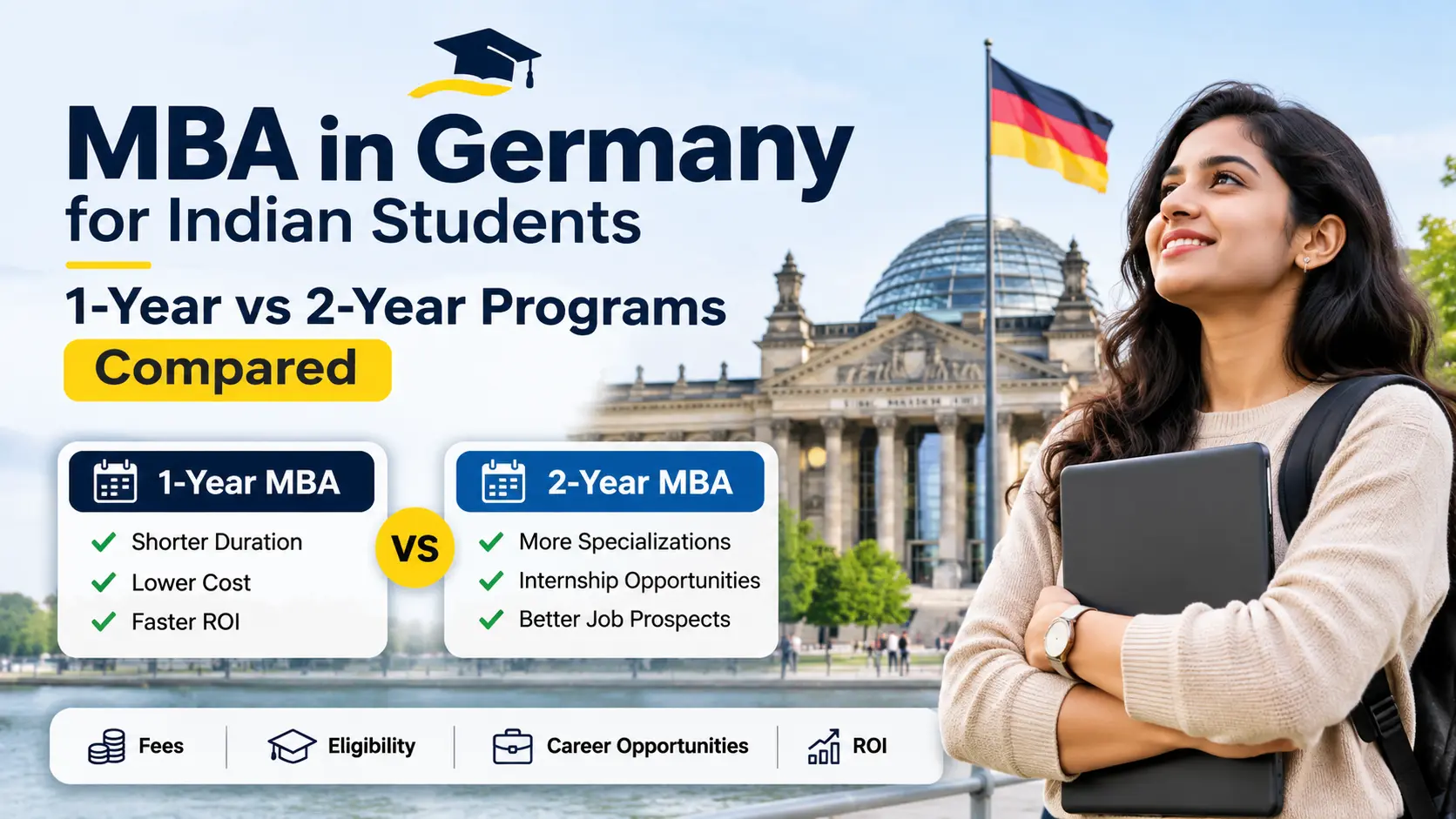
Choosing between a 1-year and 2-year MBA in Germany is not simply a decision about how quickly you want to graduate. It can affect your total education budget, opportunities for practical experience, career transition plans, and the time you have to establish professional connections in Europe.
For Indian students, the distinction is particularly important because MBA programmes in Germany have different admission expectations. Some are designed for experienced professionals seeking career advancement, while others offer a longer academic structure with opportunities to explore management specialisations.
A shorter programme is not necessarily better value, just as a longer programme does not automatically offer better career prospects. The right choice depends on your professional experience, financial capacity, and intended career path.
1-Year vs 2-Year MBA in Germany: Key Differences
| Comparison factor | 1-Year MBA | 2-Year MBA |
| Duration | Approximately 12 months | Approximately 24 months |
| Learning structure | Intensive academic schedule | More extended academic schedule |
| Work experience | Often designed for experienced professionals | Depends on university and programme |
| Specialisation | Depends on available electives | Potentially more time for electives |
| Internship opportunities | May be limited by the schedule | Potentially more flexibility |
| Living expenses | Generally lower due to shorter stay | Generally higher due to longer stay |
| Career transition | Faster return to employment | More time for exploration and networking |
| Best suited for | Professionals with defined career goals | Students seeking an extended learning experience |
These are general differences, not universal rules. Some programmes have 15–18-month structures, and internship availability depends on individual university regulations.
One-Year MBA in Germany: An Intensive Route to Management Careers
A 1-year MBA is generally suitable for professionals who already have industry experience and want to strengthen their management, leadership and strategic decision-making skills without spending two academic years away from employment.
The curriculum usually concentrates on subjects such as finance, marketing, business strategy, operations, leadership, and organisational management into a shorter period.
Example: WHU – Otto Beisheim School of Management
WHU offers a Full-Time MBA structured around a one-year study period. Its admission requirements include a recognised bachelor’s degree, at least two years of postgraduate work experience, and English-language proficiency.
Advantages of a 1-year MBA
- Reduced living expenses: Students spend less time paying for accommodation, food, transport and other everyday expenses.
- Faster career progression: Professionals can return to the employment market sooner.
- Focused learning: The intensive structure allows students to concentrate on essential management subjects.
- Suitable for career advancement: Applicants with relevant experience can build on their existing industry knowledge.
What is the limitation?
The academic schedule can be demanding. Students may have less flexibility to undertake additional internships, explore electives, or learn German alongside their studies. Applicants should check whether practical projects and career-development activities are integrated into the programme.
Two-Year MBA in Germany: More Time for Academic and Professional Development
A 2-year MBA can suit students who want a longer learning experience, particularly when the programme includes specialised coursework, international exposure, or practical training.
However, it is important to distinguish between a full-time two-year MBA and a part-time MBA that takes two years to complete. They are not interchangeable.
Example: TU Bergakademie Freiberg
The university’s International Business and Resources in Emerging Markets MBA is a four-semester, full-time programme taught in English. Its curriculum combines international management, economics and development-related subjects.
What makes this programme particularly relevant is its practical structure:
- An optional internship of at least nine weeks can earn 10 ECTS credits.
- Students can pursue an international semester or selected double-degree opportunities.
- German language courses are offered during the first two semesters.
- The programme does not charge tuition fees, although semester contributions and living expenses apply.
According to its DAAD programme listing, the estimated living expenses are €650–€950 per month, depending on lifestyle.
Advantages of a 2-year MBA
- Extended learning: More time to study management concepts and explore specialised subjects.
- Practical exposure: Certain programmes provide opportunities for internships, consulting projects, or international study.
- Networking: Students have a longer period to build relationships with classmates, faculty, and industry professionals.
- Language development: Additional time can help international students improve their German proficiency.
What should students consider?
Two years in Germany generally mean higher cumulative accommodation, food, insurance, and personal expenses. Students should also assess whether the additional study period offers enough academic or professional value to justify the cost.
What Will an MBA in Germany Cost?
Comparing tuition fees alone can give Indian applicants an incomplete picture. The total budget should include:
| Expense | What to consider |
| Tuition fees | Depends on the university and MBA format |
| Semester contribution | Applicable university and student-service charges |
| Accommodation | Rent, utilities, and housing deposits |
| Health insurance | Coverage required during studies |
| Daily expenses | Food, transport, and personal costs |
| Additional costs | Books, travel, applications, and other expenses |
For illustration, the DAAD listing for TU Bergakademie Freiberg estimates living expenses of €650–€950 monthly. This would mean approximately €7,800–€11,400 for 12 months and €15,600–€22,800 for 24 months, excluding other costs.
This illustrates why programme duration matters financially. However, do not assume that every 1-year MBA costs less overall: private business schools can charge considerably higher tuition fees.
Admission Requirements for Indian Students
Most traditional MBA programmes expect applicants to have an undergraduate degree and relevant professional experience. Requirements vary by institution.
Common application requirements include:
- A recognised bachelor’s degree and academic transcripts.
- Relevant professional experience, often ranging from one to several years.
- English proficiency through IELTS, TOEFL or accepted alternatives.
- GMAT or GRE scores, where required.
- A statement of purpose, CV, and recommendation letters.
- APS certification, where applicable to the applicant and programme.
For example, TU Bergakademie Freiberg generally requires one year of work experience and a GMAT score of at least 570 or the specified GRE alternative. WHU requires at least two years of postgraduate professional experience.
Always verify the latest requirements on the university’s official admission page before applying.
Which MBA Duration Is Better for Your Career Goals?
The right programme depends on what you want to achieve after graduation.
| Applicant profile | Programme worth considering |
| Experienced professional seeking faster career progression | 1-year MBA |
| Professional planning an industry or role change | 1-year or extended MBA, depending on career support |
| Student interested in international projects and internships | 2-year MBA with practical components |
| Applicant seeking a specialised management curriculum | Whichever duration offers the relevant specialisation |
| Student balancing education with employment | Part-time MBA |
There is another important consideration: your post-study employment options do not automatically depend on whether you complete a 1-year or 2-year MBA.
According to the German government’s official post-study guidance, eligible graduates of German higher education institutions can apply for a residence permit of up to 18 months to seek qualified employment. During this period, they can work in any occupation while looking for suitable skilled employment.
International students can also work up to 140 full days or 280 half-days annually during their studies, subject to applicable residence rules. Refer to the government’s student work regulations.
How YES Germany Can Help You Select an MBA
Choosing an MBA requires evaluating programme duration alongside admission criteria, tuition fees, curriculum, and career opportunities. YES Germany assists Indian students with university shortlisting, application procedures, APS certification, German language preparation, financial documentation, and student-visa guidance.
Reviewing these factors before applying can help you select a programme that matches your academic background, professional experience, and career objectives.
Conclusion
A 1-year MBA in Germany can be suitable for experienced professionals who want an intensive management qualification and a quicker return to employment. A 2-year MBA can offer a longer academic experience, with opportunities for internships, specialised learning and professional networking, depending on the university.
Rather than choosing based on duration alone, compare the curriculum, total expenses, practical exposure and career support. The best MBA is not necessarily the shortest or longest programme, but the one that delivers the strongest value for your professional goals.
Frequently Asked Questions
1. Can Indian students pursue an MBA in Germany immediately after graduation?
Some programmes accept applicants with limited work experience, but many traditional MBA programmes expect prior professional experience. Check individual admission criteria.
2. Are MBA programmes in Germany taught entirely in English?
Several international MBA programmes are taught entirely in English. However, German proficiency can be beneficial when applying for internships and employment.
3. Is GMAT compulsory for every MBA in Germany?
No. Some universities require GMAT or GRE scores, while others accept alternative admission assessments or do not require these tests.
4. Do German universities offer MBA scholarships to Indian students?
Some universities and external organisations offer financial assistance. Eligibility, funding amounts, and application deadlines vary by scholarship.
5. Is a German MBA suitable for someone planning to work in another European country?
It can be, depending on the programme’s recognition, international exposure, professional network, and the employment and immigration requirements of the destination country.