
Germany’s engineering reputation is supported by a network of universities known for their contributions to technology, scientific research, and industrial innovation. Among them is the TU9 Alliance, a group of nine established technical universities that bring together expertise in engineering, natural sciences, and interdisciplinary research.
For Indian students considering a Bachelor’s or Master’s degree in Germany, TU9 offers a useful starting point for exploring technical universities beyond familiar names such as TUM and RWTH Aachen. However, membership alone should not determine your choice. The right university depends on your intended specialisation, academic background, language preferences, admission eligibility, and budget.
What Is TU9 in Germany?
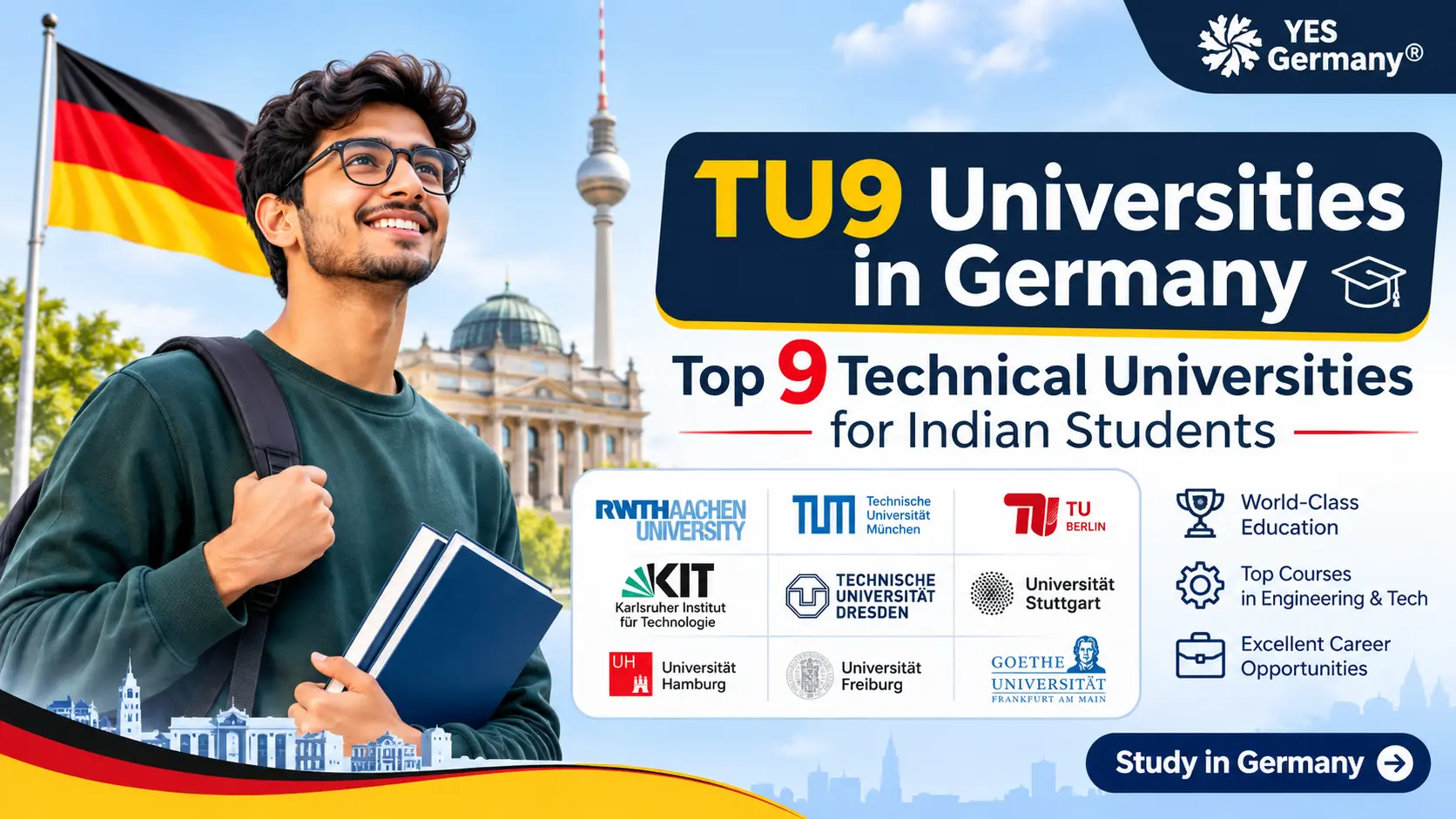
TU9 stands for German Universities of Technology. It is an alliance of nine leading technical universities that collaborate in research, innovation, engineering education, and international academic cooperation.
The alliance originated in 2003 as an informal association of university leaders and became a registered non-profit organisation in 2006. Its name was changed to TU9 – German Universities of Technology in 2018. The same nine founding universities continue to form the alliance.
An important distinction for applicants is that TU9 is neither a university ranking nor a separate accreditation system. Membership indicates participation in an alliance of research-intensive technical universities. It does not mean that all members have identical admission standards, tuition policies, or programme structures.
According to its current study information, TU9 universities offer more than 1,300 degree programmes, including over 280 English-taught Master’s programmes. Their academic offerings also extend beyond engineering to natural sciences, life sciences, humanities, and social sciences.
The Nine Universities in the TU9 Alliance
Although all nine universities have a strong technical and research orientation, their academic profiles and locations differ. The following comparison can help Indian applicants identify institutions worth exploring for their preferred specialisation.
| TU9 university | Location | Areas to explore |
| RWTH Aachen University | Aachen | Mechanical engineering, production technology, materials science, mobility, and electrical engineering |
| Technische Universität Berlin | Berlin | Computer science, electrical engineering, urban systems, and sustainable technologies |
| Technische Universität Braunschweig | Braunschweig | Mobility, transport engineering, aerospace-related research, and mechanical engineering |
| Technical University of Darmstadt | Darmstadt | Computer science, cybersecurity, electrical engineering, materials, and mechanical engineering |
| TUD Dresden University of Technology | Dresden | Microelectronics, materials science, electrical engineering, civil engineering, and computer science |
| Leibniz University Hannover | Hannover | Production engineering, energy systems, optical technologies, and biomedical research |
| Karlsruhe Institute of Technology (KIT) | Karlsruhe | Computer science, energy, mechanical engineering, electrical engineering, and materials science |
| Technical University of Munich (TUM) | Munich and other campuses | Robotics, aerospace, artificial intelligence, mobility, and biotechnology |
| University of Stuttgart | Stuttgart | Automotive technology, aerospace engineering, production technology, and computational engineering |
These are broad areas to investigate, not official rankings of departmental strengths. Applicants should confirm the availability, language, and admission requirements of individual degree programmes through the universities’ course catalogues.
What makes each university worth exploring?
1. RWTH Aachen University
RWTH Aachen’s academic and research activities span traditional engineering disciplines as well as emerging technologies. Students interested in manufacturing, automotive engineering, and industrial research can explore its programme portfolio.
2. Technische Universität Berlin (TU Berlin)
Located in Germany’s capital, TU Berlin’s programmes and research activities cover areas such as electrical engineering, information technology, sustainable technologies, and urban development.
3. Technische Universität Braunschweig
TU Braunschweig’s academic and research interests include automotive technologies, aerospace, mechanical engineering, and transport systems. Applicants interested in interdisciplinary mobility research should examine its specialised offerings.
4. Technical University of Darmstadt
TU Darmstadt’s research areas include Energy and Environment, Information and Intelligence, and Matter and Materials. It is worth exploring for students interested in combining conventional engineering with digital technologies.
5. TUD Dresden University of Technology
TUD Dresden’s research environment is particularly relevant to students interested in microelectronics, advanced materials, and interdisciplinary technological development.
6. Leibniz University Hannover
Leibniz University Hannover combines engineering and natural sciences with interdisciplinary research. Its areas of interest include production engineering, energy, optical technologies, and biomedical research. Students considering sustainable engineering and manufacturing-related programmes can explore its academic offerings.
7. Karlsruhe Institute of Technology (KIT)
KIT combines university education with large-scale research activities. Its academic profile covers computer science, engineering, energy, materials science, and environmental technologies. Its research links with the Helmholtz Association make it an option worth considering for students interested in research-oriented education.
8. Technical University of Munich (TUM)
TUM is one of Germany’s internationally recognised technical universities. Its academic offerings cover engineering, computer science, natural sciences, and management, with research interests in areas such as robotics, aerospace, artificial intelligence, and mobility. International applicants should pay particular attention to its tuition-fee policy when planning their finances.
9. University of Stuttgart
The University of Stuttgart is relevant to students interested in automotive technology, aerospace engineering, production technologies, and computational sciences. Its location in an important industrial region also provides a useful context for understanding the relationship between engineering research and industrial applications.
Why Should Indian Students Consider TU9 Universities?
For Indian applicants, the value of exploring TU9 extends beyond the reputation of its member institutions.
Research-oriented education: TU9 universities combine scientific research with academic teaching. This can be particularly relevant to students considering research-intensive Master’s programmes, doctoral studies, or careers in technology development.
Choice of specialised disciplines: Students can explore fields beyond conventional mechanical and computer engineering, including microelectronics, computational engineering, robotics, renewable energy, aerospace, and materials science.
International academic environment: TU9 institutions welcome international students and researchers. Their International Offices provide information about applications, admission requirements, language support, and student services.
Research and industry exposure: Collaboration with companies, research organisations and technology partners can help students understand how academic knowledge is applied in professional settings. However, internships, placements, and employment opportunities are not guaranteed by TU9 membership and depend on individual programmes and eligibility.
Admission Requirements for Indian Students
TU9 membership does not create a common admission process. Each university independently determines its eligibility criteria, application deadlines, language requirements, and selection procedures.
Requirements also differ between Bachelor’s and Master’s programmes.
Bachelor’s admission
Indian students completing Class 12 should pay particular attention to Germany’s higher education entrance qualification requirements.
For admissions from Winter Semester 2026/27 onwards, updated criteria specify a minimum overall score of 70% in the Indian Class 12 examination. Relevant pathways include:
- Class 12 with at least 70%: Applicants with the required APS documentation may qualify for subject-restricted admission through Studienkolleg, followed by the FeststellungsprüfuWinter Semester 2026/27ng (FSP).
- Class 12 plus one successful Bachelor’s academic year: Applicants with at least 70% in Class 12 who have successfully completed one academic year in a recognised Bachelor’s programme may qualify for direct, subject-restricted admission in their previous field or closely related subjects.
- JEE Advanced: A qualifying JEE Advanced result remains another recognised pathway for eligible technology and natural-science programmes.
These pathways do not guarantee admission. Universities assess applications independently and may impose additional subject-specific conditions.
Master’s admission
Indian applicants generally need a recognised Bachelor’s degree in a relevant or closely related subject. Universities may evaluate:
- Previous academic performance and subject-specific grades.
- Undergraduate coursework and credit requirements.
- Mathematical, scientific, or technical foundations.
- English or German language proficiency.
- Additional requirements such as aptitude assessments, where applicable.
For example, an applicant interested in a Master’s in Mechanical Engineering should check whether their undergraduate curriculum meets the programme’s subject and credit requirements. Holding an engineering degree alone does not guarantee eligibility.
Language requirements
Although TU9 universities offer several English-taught Master’s programmes, German remains the primary language of instruction for many degree programmes in Germany.
English-taught courses generally require recognised English proficiency certificates, while German-taught programmes require the qualifications specified by the university. Applicants should check the accepted certificates, minimum scores, and any additional language conditions for their chosen course.
The TU9 English Master’s Programmes 2026/27 directory is a useful starting point for identifying English-taught options. Always verify the latest details on the individual university’s website.
APS certification and dMAT for Indian applicants
Indian students should also account for the Academic Evaluation Centre (APS) procedure. APS India verifies academic documents and qualifications issued by Indian educational institutions. Its certificate is generally required as part of German student visa documentation, subject to applicable exemptions.
An additional update is important for Indian Master’s applicants. The Digital Master Test (dMAT) is now a required part of APS documentation for selected applicant groups, including applicants whose previous degree is a B.Tech, B.Eng, or another qualifying engineering degree. The requirement applies to relevant Master’s intakes from Summer Semester 2027 onwards, subject to transitional exemptions.
The confirmed 2027 test dates are 16 January and 13 March 2027. Applicants may submit their APS documents before receiving the dMAT certificate, but APS can issue the final certificate only after the required result has been verified.
The dMAT is administered by g.a.s.t. and does not replace APS document verification or university admission requirements.
What Does It Cost to Study at a TU9 University?
Germany’s public universities are often associated with comparatively affordable higher education. However, Indian students should not assume that every TU9 institution offers tuition-free education.
Tuition policies can differ by university, federal state, and degree programme. Three institutions require particular attention:
- Technical University of Munich: Non-EU/EEA students generally pay programme-dependent tuition fees. From Winter Semester 2027/28, the published rates are €2,300 or €3,400 per semester for Bachelor’s programmes and €4,600 or €6,800 per semester for Master’s programmes.
- Karlsruhe Institute of Technology: Non-EU students generally pay €1,500 per semester under Baden-Württemberg’s international tuition-fee rules, subject to exemptions.
- University of Stuttgart: Non-EU students generally pay €1,500 per semester, in addition to the regular semester contribution, subject to applicable exemptions.
Students should also budget for accommodation, health insurance, food, transportation, and other living expenses.
Before accepting an admission offer, compare the programme’s tuition fees, semester contribution, estimated living expenses, and available funding options.
How YES Germany Can Help You Choose a TU9 University
Selecting a university solely on the basis of reputation can lead to a mismatch between your academic background and the programme you intend to pursue. A more effective approach is to evaluate your previous education, preferred specialisation, career objectives, budget, and eligibility before preparing applications.
YES Germany supports Indian students through university and course selection, application procedures, APS certification guidance, German language preparation, financial documentation, and student visa assistance.
Understanding these requirements early can help applicants develop a realistic university shortlist and prepare for higher education in Germany.
Frequently Asked Questions About TU9 Universities
1. Can students apply to multiple TU9 universities at the same time?
Yes. Applicants can submit separate applications to multiple member universities, provided they meet each programme’s eligibility requirements and deadlines.
2. Is there a common TU9 application portal?
No. Each university manages its own admissions process. Applicants must follow the application instructions of their chosen institution and programme.
3. Are all Master’s programmes at TU9 universities taught in English?
No. Although TU9 universities offer more than 280 English-taught Master’s programmes, many courses are taught in German or require proficiency in both languages.
4. Do TU9 universities guarantee internships or job placements?
No. Research and industry collaborations may create opportunities, but internships and employment depend on the programme, employer requirements, individual qualifications, and availability.
5. Can students study subjects other than engineering at TU9 universities?
Yes. Their academic offerings also include natural sciences, mathematics, computer science, life sciences, and selected humanities and social science disciplines.