Germany has quietly become the smartest study-abroad destination for Indian students — and 2027 is shaping up to be its biggest year yet. With world-class public universities charging little to no tuition, a job market crying out for skilled graduates, and a new Opportunity Card (Chancenkarte) making post-study migration easier than ever, over 50,000 Indian students are already building their futures here.
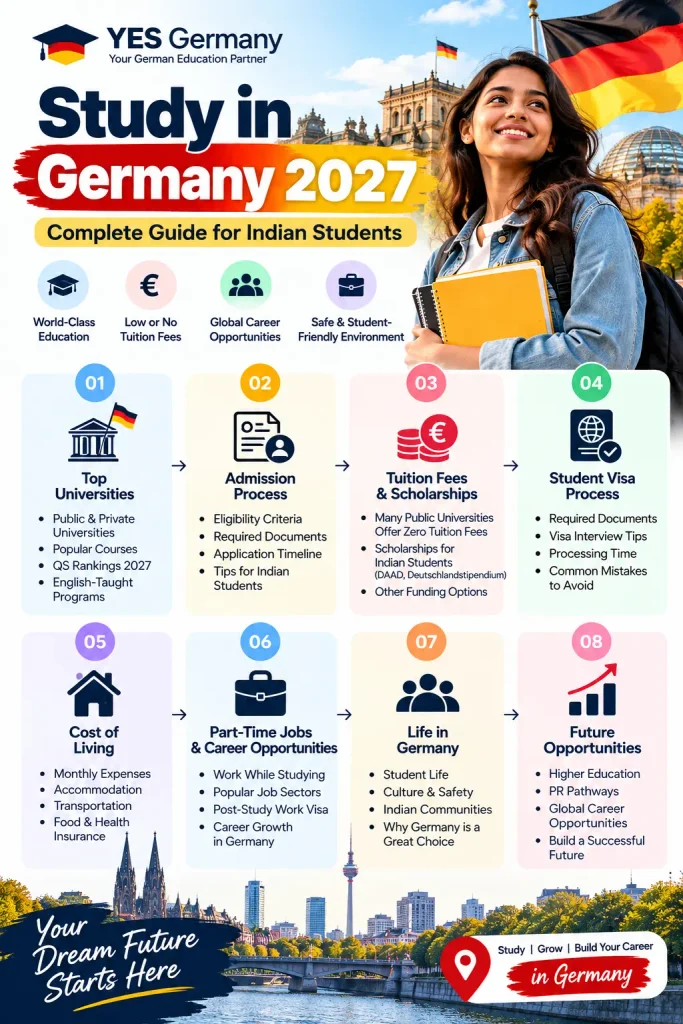
If you are an Indian student aiming for an engineering degree, an MS in computer science, an MBA with global exposure, or your parents are weighing the return on investment of a European education, this guide walks you through everything you need to know to study in Germany in 2027 — the costs, the universities, the visa process, scholarships, and life after graduation.
Why Germany Is the Top Choice for Indian Students in 2027
Germany is now the third most popular destination for Indian students worldwide, and the numbers keep climbing for very good reasons:
- No tuition fees at public universities — most public institutions charge only a semester contribution of €150–€350
- 450+ English-taught Bachelor’s, Master’s, and MBA programs — you do not need to learn German before you apply
- 18-month post-study work visa — the longest among top study destinations
- Chancenkarte (Opportunity Card) — a points-based residence permit that fast-tracks skilled graduates into permanent roles
- Strongest economy in Europe — home to global giants like BMW, Siemens, SAP, Bosch, Mercedes-Benz, Volkswagen, and Deutsche Bank
- Safe, student-friendly cities — Berlin, Munich, Hamburg, Frankfurt, Stuttgart, and Heidelberg consistently rank among the world’s best student cities
Want a deeper look at the advantages? Explore our complete breakdown on Why Germany is the right choice for your higher education.
Cost of Studying in Germany for Indian Students
One of the biggest reasons Indian parents choose Germany is affordability without compromise. Here is a realistic 2027 cost breakdown:
| Expense Category | Public University | Private University |
|---|---|---|
| Tuition Fees (per year) | €0 – €1,500 | €10,000 – €25,000 |
| Semester Contribution | €150 – €350 | Included in tuition |
| Blocked Account (per year) | €11,904 | €11,904 |
| Accommodation (monthly) | €350 – €700 | €400 – €800 |
| Food & Groceries (monthly) | €200 – €300 | €200 – €300 |
| Health Insurance (monthly) | €120 – €130 | €120 – €130 |
| Public Transport (monthly) | €30 – €80 | €30 – €80 |
Total Annual Cost at a Public University: approximately ₹13 – ₹17 lakhs, including living expenses — significantly lower than the US, UK, Canada, or Australia for a comparable or better quality of education.
Every student applying for a German study visa must deposit a mandatory blocked account amount of €11,904. Our dedicated German Blocked Account service makes this process smooth and quick for Indian families.
For those financing their education through a loan, YES Germany’s Study Loan assistance connects you with partnered banks offering competitive interest rates and faster approvals.
Top Universities in Germany for Indian Students
Germany is home to over 400 recognised higher-education institutions, including some of the oldest and most prestigious universities in Europe. Here are the ones Indian students apply to most:
Public Universities (Globally Ranked, Tuition-Free)
- Technical University of Munich (TUM) — world-leading in engineering, computer science, and management
- RWTH Aachen University — Germany’s top engineering university
- Heidelberg University — Germany’s oldest, strong in medicine, natural sciences, and humanities
- Humboldt University of Berlin — top-ranked for arts, humanities, and social sciences
- Technical University of Berlin (TU Berlin) — strong in engineering, architecture, and planning
- University of Freiburg — renowned for environmental sciences and medicine
- University of Stuttgart — the hub for automotive and mechanical engineering
- Karlsruhe Institute of Technology (KIT) — one of the TU9 elite engineering universities
Private Universities (Industry-Linked, Taught in English)
- GISMA Business School
- EU Business School (Munich)
- Berlin School of Business and Innovation
- IU International University of Applied Sciences
- Munich Business School
Many of these universities actively recruit Indian students and offer rolling admissions, pathway programmes, and conditional offers based on your academic profile.
Popular Courses to Study in Germany for Indian Students
Germany is best known for its engineering and technology programmes, but the course catalogue is far wider. Here is where Indian students are heading in 2027:
Bachelor’s in Germany
The three to four-year undergraduate degree is a popular path for students right after Class 12. Top choices include Mechanical Engineering, Computer Science, Business Administration, Automotive Engineering, and Industrial Design. Learn more about Bachelor in Germany programmes, eligibility, and application timelines.
MS in Germany
Germany is a global leader in postgraduate STEM education. The most in-demand specialisations for Indian students include:
- MS in Computer Science & Artificial Intelligence
- MS in Data Science & Machine Learning
- MS in Mechanical Engineering
- MS in Automotive Engineering (hello, BMW and Mercedes!)
- MS in Renewable Energy & Sustainability
- MS in Embedded Systems
- MS in Robotics
Our complete guide on MS in Germany covers university shortlisting, GRE/IELTS requirements, SOPs, and application support.
MBA in Germany
An MBA from Germany is a strong career move for Indian professionals with 2–5 years of work experience. Programmes are often one year, taught in English, and backed by placements with multinationals headquartered in Germany. See our full MBA in Germany guide for one-year vs two-year programmes, fees, and the best business schools.
Engineering in Germany
Germany is engineering. Whether it is Automotive, Mechanical, Electrical, or Civil Engineering, German universities deliver the strongest technical education in the world, with hands-on labs, industry internships, and direct hiring pipelines. Explore all Engineering in Germany options tailored for Indian students.
Admission Requirements for Indian Students
Admission requirements vary by programme, but here is what Indian students typically need:
For a Bachelor’s degree:
- Class 12 marksheet with 60%+ (some universities require a one-year foundation programme called Studienkolleg)
- IELTS 6.0+ or TOEFL iBT 80+ for English-taught programmes
- German language proficiency (B1 or higher) for German-taught programmes
- Statement of Purpose (SOP) and Letters of Recommendation (LORs)
- Valid passport
For a Master’s degree:
- Bachelor’s degree with 65%+ (CGPA 7.0+ equivalent)
- IELTS 6.5+ or TOEFL iBT 90+
- GRE (recommended for top universities, not mandatory everywhere)
- APS Certificate — now compulsory for all Indian students applying to German universities
- SOP, LORs, updated CV, portfolio (for design/architecture)
For an MBA:
- Bachelor’s degree
- 2–5 years of work experience
- GMAT 600+ (for top business schools)
- IELTS/TOEFL and professional LORs
Even if you plan to study in English, learning basic German up to A1 or A2 level makes life in Germany far smoother — and opens up part-time job opportunities. Our structured German Language courses from A1 to B2 are designed specifically for Indian students.
Germany Student Visa Process for Indian Students
Once you receive your admission letter, the visa process is the most important step. Here is how it works for Indian applicants:
- Receive your Admission Letter from a recognised German university
- Open your Blocked Account and deposit €11,904 (one year’s living expenses)
- Apply for the APS Certificate at the German Embassy in New Delhi — mandatory for all Indian students since November 2022
- Buy student health insurance valid in Germany
- Book your VFS Germany visa appointment at the nearest centre (Delhi, Mumbai, Bangalore, Chennai, Kolkata)
- Attend your visa interview with all required documents
- Receive your National D-Visa in 6–12 weeks
- Travel to Germany and apply for your residence permit within 90 days of arrival
A well-prepared visa file has a 95%+ approval rate. Our team handles every step of the visa process for YES Germany students — from document preparation to interview coaching.
Scholarships to Study in Germany for Indian Students
Although public universities already charge little to no tuition, scholarships further ease the financial load. The most popular ones for Indian students include:
- DAAD Scholarships — the German Academic Exchange Service offers hundreds of fully-funded scholarships every year (learn more at the official DAAD India portal)
- Deutschlandstipendium — €300/month merit-based scholarship open to international students
- Erasmus Mundus Joint Masters — fully-funded, taught across multiple European universities
- Heinrich Böll Foundation Scholarship — for socially engaged students
- Konrad-Adenauer-Stiftung Scholarship — for postgraduate and doctoral students
- University-specific scholarships — TUM, RWTH Aachen, and Heidelberg offer merit scholarships for international candidates
Start your scholarship applications 8–10 months before your intake, keep your SOP sharp, and apply to at least 4–5 scholarships to maximise your chances.
Life as an Indian Student in Germany
Life in Germany is well-balanced, safe, and remarkably affordable compared to other Western countries. Students enjoy excellent public transport, a strong Indian community in cities like Munich, Berlin, Hamburg, and Stuttgart, access to Indian groceries and restaurants, and the freedom to travel across all 29 Schengen countries on a single visa.
International students are legally allowed to work 120 full days or 240 half days per year, earning €12–€15 per hour on average. Popular part-time options include working as a research assistant, in cafes and restaurants, as a delivery associate, or in retail stores.
Career Opportunities After Graduation
This is where Germany truly stands apart. The country has over 400,000 open skilled-worker vacancies and desperately needs international talent. After completing your degree, you automatically get an 18-month post-study work visa to find a job that matches your qualifications.
Average starting salaries for Indian graduates in 2027:
- Engineering & IT: €55,000 – €75,000 per year
- Data Science & AI: €60,000 – €85,000 per year
- MBA Graduates: €65,000 – €90,000 per year
- Mechanical / Automotive Engineering: €55,000 – €80,000 per year
After two years of working in Germany, you can apply for the EU Blue Card, and permanent residency (PR) is possible in as little as 21 months if your German language proficiency is at B1 level.
Final Thought
Studying in Germany in 2027 is not just about earning a world-class degree — it is a complete career launchpad. Low tuition, globally ranked universities, English-taught programmes, and a clear pathway to work and settle in Europe make it the single best study-abroad decision an Indian student can make right now.
But the German application process is detail-heavy. APS certification, blocked accounts, university shortlisting, SOPs, visa documentation — one wrong step and your admission or intake can be delayed by a full semester.
That is where YES Germany steps in. As India’s leading study-in-Germany consultancy, we have successfully guided thousands of Indian students into top German universities with end-to-end support — from course selection to the day you land in Germany, and even after you arrive.
Ready to begin your Germany journey? 👉 Book a free counselling session with our Germany education experts today and get a personalised roadmap for your 2027 intake. Your dream of studying in Germany is one conversation away.
FAQs
1. Is Germany a good option for Indian students in 2027?
Yes, Germany is an excellent destination for Indian students, offering quality education, internationally recognised degrees, affordable tuition, and strong career opportunities.
2. Can Indian students study in Germany for free?
Many public universities in Germany offer tuition-free or low-tuition education. However, students may need to pay semester contributions and living expenses.
3. What are the eligibility requirements to study in Germany?
Indian students generally need recognised academic qualifications, proof of language proficiency (IELTS, TOEFL or German), and other course-specific admission requirements.
4. How much does it cost to live in Germany as a student?
Living expenses generally range from €900 to €1,200 per month, depending on the city, accommodation, lifestyle, and personal spending.
5. Can Indian students work part-time while studying in Germany?
Yes, international students can generally work up to 140 full days or 280 half days per calendar year under Germany’s student employment rules.
6. Can Indian students stay in Germany after graduation?
Yes, eligible international graduates can apply for an 18-month residence permit to find qualified employment related to their studies.