Every year, thousands of Indian students receive their admission letters from German universities — and then panic about the visa interview. At YES Germany, we have guided over 2,000 students through this exact stage, and we can tell you one thing with confidence: the Germany visa interview questions for Indian students in 2027 are not designed to trick you. They are designed to check whether your intent, finances, and documents are genuine.
This guide breaks down the most common German student visa interview questions, gives you sample answers you can adapt, and shares the preparation strategy that has helped our students maintain a consistently high visa success rate.
How Does the Germany Student Visa Interview Work?
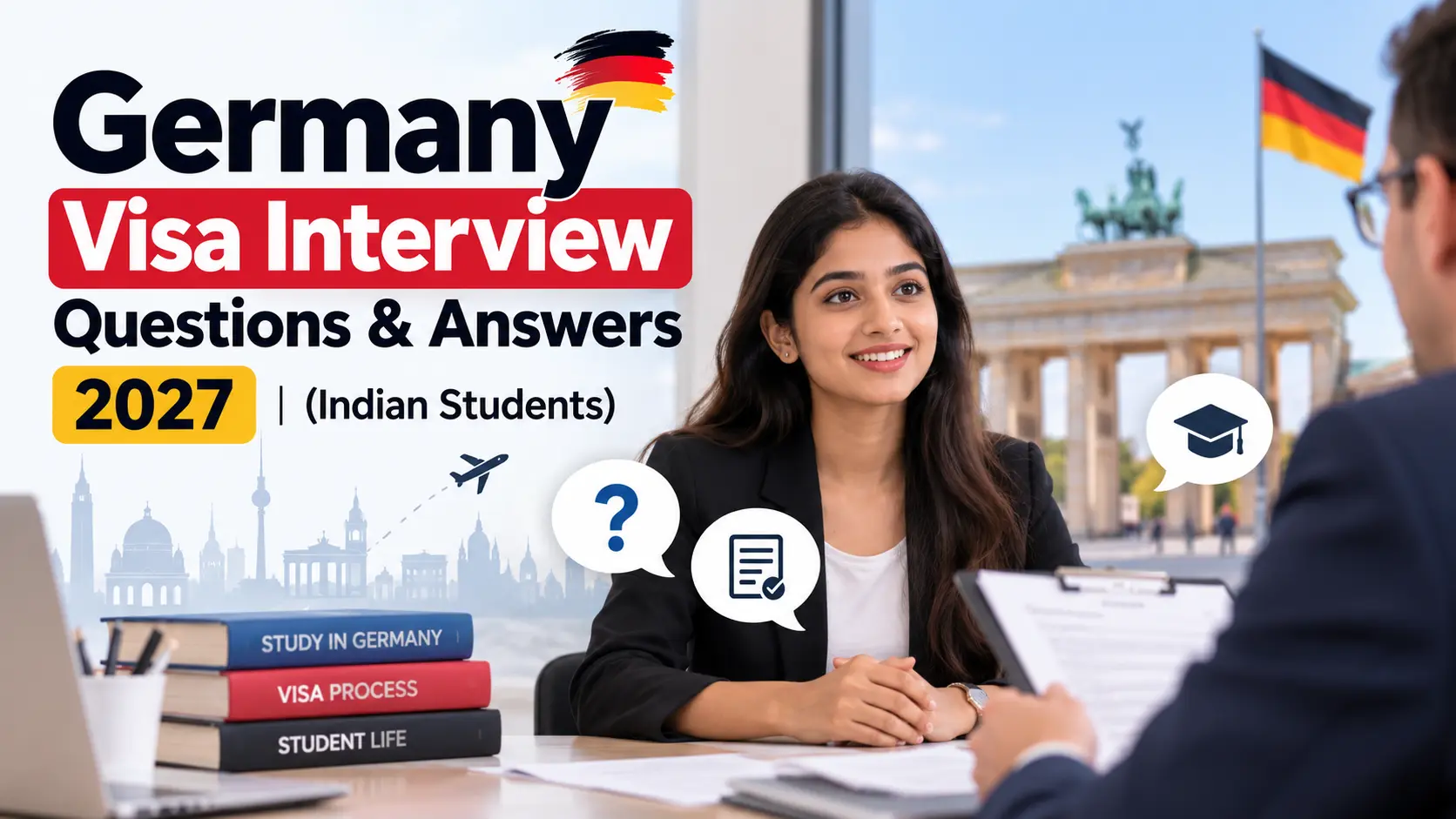
Before we look at the questions, let us quickly cover what actually happens during the interview. Indian students applying for a German student visa attend an in-person appointment at the German Embassy in New Delhi, the Consulate in Mumbai, Chennai, Kolkata, or Bengaluru — or through VFS Global centres.
The interview typically lasts 10 to 15 minutes. A consular officer will ask you questions in English (sometimes in German if your course is German-taught). They are evaluating three things:
- Your genuine study intent — Do you actually plan to study, or is this a migration route?
- Your financial readiness — Can you afford to live and study in Germany?
- Your clarity — Do you understand your own course, university, and future plan?
There is no pass or fail score. The officer simply needs to be convinced that your application is truthful and well-prepared.
Common Germany Visa Interview Questions and Answers for 2027
The following questions come up in almost every German student visa interview for Indian applicants. We have included sample answers, but remember — your responses must be genuine and consistent with your documents. Do not memorise scripts. Understand the logic behind each question and answer in your own words.
1. Why do you want to study in Germany?
Sample Answer: “Germany offers tuition-free education at public universities, which makes it financially practical for me. Beyond that, German universities are globally respected for engineering and technology programmes. I specifically chose Germany because my course includes industry-integrated projects, which is not common in Indian universities at the same level.”
What they are checking: Whether you have a real, logical reason — not just “Germany is a good country.”
2. Why did you choose this university and course?
Sample Answer: “I chose TU Munich’s M.Sc. in Computational Science because it combines applied mathematics with computer science, which aligns with my bachelor’s in Computer Science. The university’s partnership with Fraunhofer research institutes also gives students exposure to real-world projects.”
What they are checking: Whether you researched your programme or just applied randomly.
3. How will you finance your studies and living expenses in Germany?
Sample Answer: “I have opened a blocked account with €11,904, which covers my first year’s living expenses at €992 per month. My father is also sponsoring additional costs, and I have submitted his bank statements and income tax returns as supporting documents.”
What they are checking: Whether your finances are real and sufficient. Know your blocked account details — the amount, the provider, and how monthly withdrawals work.
4. What is a blocked account?
Sample Answer: “A blocked account, or Sperrkonto, is a mandatory German bank account where I have deposited €11,904. The amount stays frozen until I arrive in Germany, and then I can withdraw up to €992 every month to cover my living expenses.”
What they are checking: Whether you actually understand your own financial documents.
5. What are your plans after completing your degree?
Sample Answer: “After finishing my master’s, I plan to apply for the 18-month post-study job seeker visa to gain professional experience in Germany. Eventually, I want to return to India and work in the automotive technology sector, where my German experience will be a strong advantage.”
What they are checking: Whether your plan sounds realistic. Avoid saying “I will settle permanently in Germany” — this raises immigration concerns.
6. Do you have family or ties in India?
Sample Answer: “Yes, my parents and younger sibling live in Pune. My father runs a business here, and I plan to return to India after gaining a few years of work experience in Germany.”
What they are checking: Whether you have enough reason to return to India.
7. Have you learned German or do you plan to?
Sample Answer: “I have completed A2-level German and plan to continue learning through the university’s language centre once I arrive. My course is taught in English, but I understand that knowing German helps with daily life and part-time work.”
8. Where will you stay in Germany?
Sample Answer: “I have applied for student housing through the Studentenwerk at my university. I also have a temporary accommodation confirmation for my first month.”
9. Have you travelled abroad before?
Answer honestly. If you have not, simply say so and explain that you have prepared well for independent living.
10. Why not study this course in India?
Sample Answer: “The curriculum in Germany includes more practical lab work, industry collaboration, and research opportunities compared to similar programmes in India. I want that hands-on exposure, which is difficult to find domestically at the same quality.”
Visa Interview Questions for Masters Students
If you are applying for a master’s programme, expect deeper questions about your academic background:
- How does your bachelor’s degree connect to this master’s course?
- Did you do any research projects or internships related to this field?
- Why a master’s and not direct work experience?
- Which professors or labs at this university interest you?
The officer wants to see a logical progression — your bachelor’s, your work or research experience, and your chosen master’s should tell a coherent story. If there is a gap or career switch, prepare a genuine explanation.
Visa Interview Questions for Bachelor Students
Bachelor applicants, especially those are applying right after 12th grade, may face questions about maturity and independence:
- Why study abroad at such a young age?
- How will you manage living alone in a foreign country?
- Do you know anyone in Germany who can support you?
- Why not complete your bachelor’s in India and then go for a master’s?
The officer is checking whether you are mentally prepared. Answer with confidence, mention any steps you have taken (language courses, budgeting research, accommodation arrangements), and stay calm.
Documents to Carry to Your Visa Interview
Disorganised documents leave a terrible impression. Arrange the following in a clear folder, ideally with labelled tabs:
- Valid passport (with at least two blank pages)
- Completed visa application form
- Two recent biometric photographs
- University admission letter (Zulassungsbescheid)
- Blocked account confirmation (Sperrbescheinigung)
- Statement of Purpose / Motivation Letter
- Academic transcripts and degree certificates
- APS certificate (if applicable)
- Health insurance confirmation
- Proof of accommodation
- Financial documents (bank statements, sponsor declaration, income proof)
Present everything neatly. The officer may not check every document, but a well-organised file signals that you are a serious, prepared applicant.
Common Mistakes Indian Students Make in Visa Interviews
After coaching hundreds of students through mock interviews, we see the same mistakes repeatedly:
Memorised, robotic answers — Officers can instantly tell when you are reciting a script. Understand your answers, do not memorise them word-for-word.
Vague motivation — Saying “Germany is a great country for education” is not enough. Be specific about your course, university, and career plan.
Not knowing your own finances — If you cannot explain your blocked account balance, your sponsor’s income, or your monthly budget, it creates doubt.
Showing immigration intent — Never say your goal is to permanently settle in Germany. Frame your plan around education, professional growth, and eventual return.
Poor document organisation — Fumbling through loose papers while the officer waits is not a good look. Prepare your file the night before.
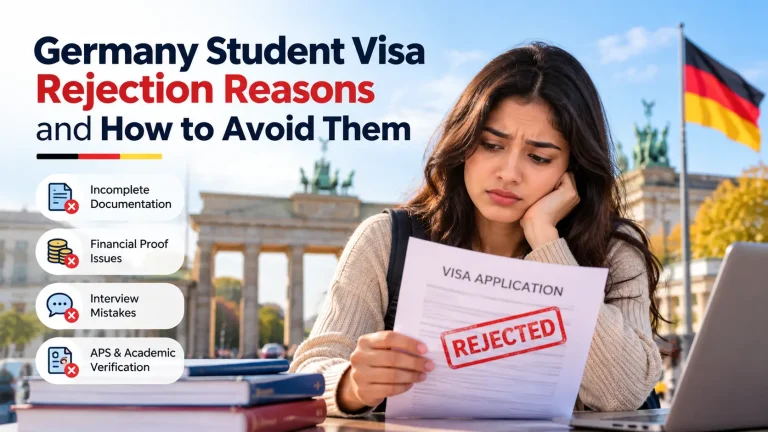
Top Reasons for Germany Student Visa Rejection from India
Understanding why visas get rejected helps you avoid those pitfalls. The most common Germany student visa rejection reasons for Indian applicants include:
- Unclear study intent — Your motivation letter or interview answers do not convincingly explain why this course, why this university, and why Germany.
- Insufficient financial proof — Blocked account amount does not meet the €11,904 requirement, or supporting financial documents are weak.
- Inconsistent information — What you say in the interview contradicts what your documents show. Always align everything.
- Weak or generic SOP — A poorly written Statement of Purpose that reads like a template can single-handedly weaken your application.
- Poor interview performance — Nervousness is understandable, but confusion, contradictions, or inability to answer basic questions raises red flags.
How YES Germany Prepares Students for Visa Interviews
At YES Germany, we do not just help with admissions — we walk with our students through every step of the visa process. Our visa interview preparation includes:
- One-on-one mock interviews where we simulate real consulate scenarios and give honest feedback
- Document review sessions to make sure every paper is in order, properly arranged, and consistent
- SOP and motivation letter assistance so your written intent matches your spoken answers
- Personalised coaching based on your specific course, university, and personal background
With 18+ years of experience and direct partnerships with over 50 German universities, our team knows exactly what consular officers look for — and how to prepare you for it.
Thinking about studying in Germany in 2027? Book a free counselling session and let us help you prepare.
Final Thoughts
The Germany visa interview questions and answers for Indian students in 2027 will follow the same pattern they have for years — your intent, your finances, your plan. The officers are not trying to catch you out. They simply want to see a genuine, well-prepared student who knows exactly why they are going to Germany and how they will manage once there.
Prepare your documents thoroughly, practise your answers out loud (but do not memorise them), and walk into that interview room with clarity and confidence. If your profile is genuine and your preparation is solid, the interview is nothing to fear.
Frequently Asked Questions
Is the Germany student visa interview difficult?
No. The interview is a brief conversation, usually lasting 10 to 15 minutes. If your documents are genuine and you can clearly explain your study plan and finances, it is straightforward.
Can my visa get rejected only because of the interview?
Yes, it is possible. If your answers are inconsistent, vague, or contradict your documents, the officer may doubt your intent and reject the application — even if your paperwork is complete.
In what language is the visa interview conducted?
Most interviews for Indian students are conducted in English. However, if your course is in German, the officer may ask a few questions in German to check your language proficiency.
How long does the Germany student visa interview last?
Typically between 10 and 15 minutes. Some interviews may be shorter if the officer is satisfied quickly.
Should I memorise my answers for the visa interview?
Absolutely not. Understand the reasoning behind each question and answer naturally in your own words. Scripted answers sound robotic and create suspicion.
What should I do if my Germany student visa gets rejected?
You can re-apply after addressing the reason for rejection. Review the rejection letter carefully, fix the weak points (whether financial, academic, or related to intent), and apply again with a stronger file. Consulting an experienced study-abroad advisor can significantly improve your chances the second time.