Choosing the right German language course is an important decision, particularly if you are learning German to study, work, or pursue vocational training in Germany. Beyond course fees, you need to consider the teaching approach, speaking practice, examination preparation, and the time required to reach your target proficiency level.
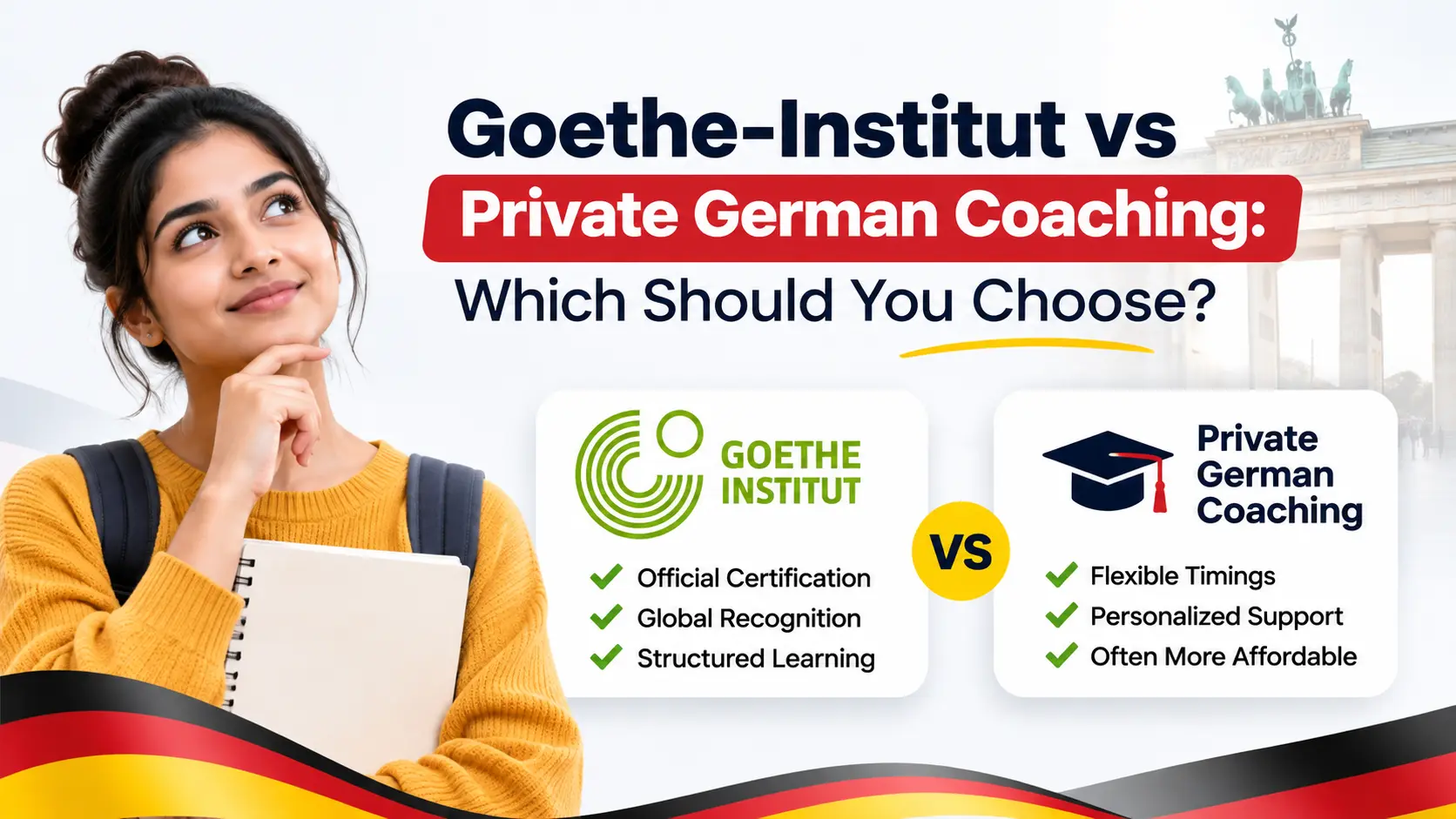
For learners in India, two common options are the Goethe-Institut and private German coaching institutes. While the Goethe-Institut offers structured language courses and conducts internationally recognised Goethe-Zertifikat examinations, private institutes provide alternative learning programmes with different teaching formats and levels of support.
So, which option should you choose? Understanding their differences can help you select a German language course that matches your learning requirements, schedule, and future plans.
Goethe-Institut vs Private German Coaching at a Glance
| Comparison factor | Goethe-Institut | Private German Coaching |
| Course structure | Structured courses following CEFR levels | Curriculum and progression depend on the institute |
| Learning formats | Classroom, online, and other formats, depending on location | Online, classroom, hybrid or individual classes, depending on the provider |
| Teaching approach | Communicative language learning | Varies by teaching methodology |
| Batch size | Depends on the specific course | Depends on the provider |
| Examination preparation | Access to official examination information and practice resources | May include mock tests, guided practice and examination-focused classes |
| Course timings | Published schedules and available batches | May offer different scheduling options |
| Certification | Separate Goethe-Zertifikat examinations | Course-completion certificates; external examination preparation may also be available |
| Fees | Vary by course format, duration, and location | Vary by institute, level and included services |
Always check the current course details, fees, and examination arrangements before enrolling.
Goethe-Institut: Structured German Language Learning
The Goethe-Institut is a cultural institution that promotes the German language and cultural exchange internationally. Its German language courses follow the Common European Framework of Reference for Languages (CEFR), covering proficiency levels from A1 to C2.
These levels represent different stages of language development:
- A1 and A2: Basic communication, everyday vocabulary, and familiar situations.
- B1 and B2: Independent communication in everyday, academic, and professional contexts.
- C1 and C2: Advanced language proficiency for complex academic, professional, and social communication.
The Goethe-Institut may be suitable for learners who prefer a structured curriculum and want to study through an established language-learning institution.
Its advantages include:
- Courses organised around recognised CEFR proficiency levels.
- Access to official Goethe-Zertifikat examination information.
- Official practice materials for different examination levels.
- Different course formats and learning intensities, depending on the location.
For example, learners can explore the Goethe-Institut New Delhi course offerings to check available formats, schedules, and fees.
One important distinction is that enrolling in a Goethe-Institut language course does not automatically award a Goethe-Zertifikat. Candidates must register for and pass the relevant examination separately.
Private German Coaching: Flexible Learning and Examination Preparation
Private German coaching institutes provide an alternative for students and working professionals who want to learn German alongside their existing commitments.
Depending on the institute, programmes may include live online classes, classroom sessions, weekend batches, intensive courses, and individual tutoring. Some providers also offer dedicated Goethe-Zertifikat preparation.
The main advantage of private coaching is the variety of programmes available. Learners can compare different teaching methods, schedules, and support arrangements before selecting a course.
However, the quality of private German coaching varies considerably. Before enrolling, consider the following:
- Does the curriculum cover all four language skills: listening, speaking, reading, and writing?
- How many instructor-led teaching hours are included?
- Does the trainer provide individual feedback on speaking and writing?
- Are regular assessments and mock examinations conducted?
- Is there a placement assessment for students with prior German knowledge?
- What support is available if you miss a class?
A demonstration class can help you evaluate the teaching approach. Pay attention to how much time students spend actively speaking German, how errors are corrected, and whether lessons encourage practical communication.
The institute’s teaching methodology and quality of feedback should matter more than its promotional claims.
Goethe-Zertifikat Preparation: Can Private Coaching Help?
You do not have to enrol in a Goethe-Institut language course to prepare for the Goethe-Zertifikat examination.
Candidates can prepare independently or through a private German coaching institute. However, they should become familiar with the examination format and practise the skills assessed at their target level.
The official Goethe-Institut examination practice resources provide exercises and practice tests for different proficiency levels, helping candidates understand the examination requirements.
A private coaching programme can complement these resources through:
- Guided speaking practice and pronunciation correction.
- Writing assignments with individual feedback.
- Timed mock examinations.
- Practice across listening and reading sections.
- Revision based on individual learning gaps.
Before selecting an examination preparation course, check whether its curriculum corresponds to your intended Goethe-Zertifikat level.
Remember: A private institute’s course-completion certificate is not equivalent to a Goethe-Zertifikat. Goethe examinations are conducted through Goethe-Instituts, Goethe-Zentren and authorised examination partners. Confirm the examination registration arrangements independently rather than assuming your coaching institute is an examination centre.
German Language Course Fees: What Should You Compare?
Course fees are an important consideration, but comparing tuition alone may not give you an accurate picture of the overall cost.
The Goethe-Institut publishes fees according to individual courses and locations. Private coaching institutes also determine their fees based on programme duration, teaching format, and included services.
Before enrolling, compare these expenses:
| Cost factor | What to verify |
| Tuition fees | Total fee for the complete proficiency level |
| Teaching hours | Number of instructor-led hours |
| Study materials | Whether textbooks and learning resources are included |
| Examination preparation | Whether mock tests and revision sessions are included |
| Additional classes | Whether missed or supplementary classes involve extra charges |
| Examination fee | Whether the Goethe-Zertifikat examination fee is separate |
| Refund policy | Applicable cancellation and withdrawal conditions |
For a fair comparison, calculate the course fee against the total number of instructor-led hours. Also consider the batch size, quality of teaching, and individual feedback.
A lower-priced course may not offer the same level of support, while a more expensive programme may include services you do not necessarily need.
Which German Language Course Should You Choose?
Your learning objective should determine which programme is appropriate.
| Your learning requirement | What to prioritise |
| Learning German from scratch | A structured A1 programme with regular speaking practice |
| Preparing for Goethe-Zertifikat | Examination-specific exercises, mock tests and individual feedback |
| Studying alongside college or work | A manageable timetable and consistent learning support |
| Applying to a German university | The exact language certificate and proficiency level required by your programme |
| Continuing from an existing proficiency level | A placement assessment to identify the appropriate course |
| Learning within a limited budget | Transparent fees, teaching hours and included resources |
If you are planning to study in Germany, check the language requirements of your intended university and degree programme before deciding on a target level.
German-taught and English-taught programmes can have different language requirements. Even among German-taught programmes, the accepted certificates and minimum proficiency levels may vary.
Completing B1 or B2 does not automatically establish eligibility for every German university. Always refer to the admission requirements of your chosen institution.
How YES Germany Supports German Language Learning
For students planning to pursue higher education in Germany, learning German can be part of a broader preparation strategy. The appropriate proficiency level depends on the intended university, programme and language of instruction.
YES Germany offers German language courses from A1 to B2 through live online classes, with weekday and weekend batch options. Its programmes also include Goethe examination preparation, allowing learners to develop their language skills while becoming familiar with the examination format.
Students can explore the YES Germany German Language Course to understand the available levels, course structure, and learning options.
When evaluating YES Germany alongside the Goethe-Institut or another private German coaching provider, consider your preferred learning format, teaching support, course duration and examination goals.
It is also important to distinguish between a course-completion certificate issued by a training provider and a separately obtained Goethe-Zertifikat.
Final Verdict: Goethe-Institut or Private German Coaching?
Both the Goethe-Institut and private German coaching institutes can support your German language learning journey, but they offer different learning experiences.
The Goethe-Institut is worth considering if you prefer its structured courses, available learning formats, and established examination resources. Private coaching may be more suitable if you find a programme that matches your schedule, learning pace, and requirements for individual support.
Before making your decision, compare the actual course curriculum, teaching hours, assessment methods, total fees, and examination arrangements.
Ultimately, the right German language course is one that helps you build practical language skills and achieve the proficiency level required for your academic or professional plans in Germany.
Frequently Asked Questions
1. Can I take the Goethe-Zertifikat examination after self-studying German?
Yes. Attending a formal language course is not compulsory. You can prepare independently and register for the examination through an authorised Goethe examination provider.
2. Is the Goethe-Zertifikat valid for university admission in Germany?
It depends on the university, degree programme and language of instruction. Check the institution’s accepted language certificates and minimum proficiency requirements before registering for an examination.
3. What is the difference between a CEFR level and a Goethe-Zertifikat?
CEFR defines language proficiency levels from A1 to C2. A Goethe-Zertifikat is an examination certificate that assesses a candidate’s German language proficiency at a particular level.
4. Can I join a B1 or B2 German course without completing the previous level at the same institute?
Yes, depending on the provider’s admission and placement assessment requirements. You may need to demonstrate your existing German proficiency before joining an advanced batch.
5. Is German language proficiency compulsory for every job in Germany?
No. Language requirements depend on the occupation, employer, and professional regulations. Some positions require a specific German proficiency level, while others may accept English-speaking applicants.