
Studying in Germany after Class 12 gives Indian students access to internationally recognised degrees, research-oriented education and industry-focused learning. However, unlike many other study destinations, Germany has specific academic eligibility requirements for international undergraduate applicants.
Depending on their qualifications, Indian students may need to complete a preparatory programme called Studienkolleg, study at a recognised Indian university for one academic year or qualify through the JEE Main and Advanced pathway.
With updated eligibility criteria applying from Winter Semester 2026/27, understanding these routes is particularly important before selecting a university.
Here is a practical roadmap to help you plan your bachelor’s education in Germany.
Step 1: Check Your Eligibility for German Universities
For Indian students, the admission pathway depends on Class 12 results and subsequent academic qualifications.
From Winter Semester 2026/27, the updated APS criteria specify a minimum of 70% of the maximum achievable marks in Class 12 for the following two pathways.
| Your academic background | Possible admission route |
| Class 12 with at least 70% | Studienkolleg followed by FSP |
| Class 12 with at least 70% and one successfully completed academic year in a recognised Indian bachelor’s programme | Direct subject-restricted admission in the previous or a related field |
| Class 12 with successful completion of both JEE Main and JEE Advanced | Separate subject-restricted admission pathway, subject to applicable conditions |
These are eligibility pathways, not guarantees of university admission. Students must also meet subject-specific and institutional requirements.
Where to check: Use the DAAD Admission Database and APS India to establish your individual eligibility.
Step 2: Choose Your Bachelor’s Course and University
Once you understand your admission route, shortlist programmes according to your academic background and career interests.
| Study area | Popular specialisations |
| Engineering | Mechanical, Civil, Electrical |
| Computer Science | Informatics, Software Engineering |
| Business | Business Administration, Economics |
| Natural Sciences | Physics, Chemistry, Biotechnology |
| Design | Industrial and Product Design |
Germany offers two major types of higher education institutions:
- Universities and Technical Universities: Focus on research and academic foundations.
- Universities of Applied Sciences: Emphasise practical learning, projects and industry-oriented education.
Compare course curricula, admission requirements, language of instruction, internship opportunities and tuition fees rather than relying exclusively on university rankings.
Remember that most bachelor’s programmes are taught in German. English-taught options exist but are comparatively limited.
Step 3: Understand Studienkolleg and the FSP Examination
Students who do not qualify for direct bachelor’s admission may need to complete a preparatory programme called Studienkolleg. It generally takes two semesters and prepares international students for the Feststellungsprüfung (FSP), an examination that establishes subject-related university entrance eligibility.
Which Studienkolleg course should you choose?
| Course | Intended specialisation |
| T-Kurs | Engineering, mathematics and technical sciences |
| W-Kurs | Business, economics and social sciences |
| M-Kurs | Medicine, biology and pharmaceutical sciences |
| G-Kurs | Humanities and German studies |
| S-Kurs | Language-related disciplines |
Universities of Applied Sciences may offer corresponding TI (technical), WW (economics), GD (design and art) and SW (social sciences) courses.
Steps involved:
- Select a Studienkolleg based on your intended bachelor’s specialisation.
- Meet its academic and German-language requirements.
- Pass the entrance examination (Aufnahmeprüfung), where required.
- Complete the preparatory programme, generally over two semesters.
- Pass the FSP examination.
- Apply separately to universities accepting your qualification.
Public vs private Studienkolleg: Public Studienkollegs generally offer tuition-free preparatory education, although semester contributions may apply. Private institutions usually charge tuition fees. Before enrolling, verify whether the institution offers a recognised FSP qualification.
An important distinction is that an FSP from a university Studienkolleg generally provides access to both universities and universities of applied sciences, whereas an FSP from a university of applied sciences Studienkolleg is generally limited to the latter.
Passing the FSP establishes subject-related eligibility but does not guarantee admission to a bachelor’s programme. Students must still meet the chosen university’s admission and selection requirements.
Step 4: Meet the Language Requirements
Language requirements depend on the preparatory institution and bachelor’s programme.
German-taught programmes: Studienkollegs commonly require German proficiency around B1–B2, with some requiring higher levels. Bachelor’s programmes generally require advanced German proficiency.
Recognised examinations may include TestDaF, DSH, Goethe-Zertifikat and telc Deutsch C1 Hochschule, depending on institutional acceptance.
English-taught programmes: Universities may accept IELTS or other approved English-language examinations.
Do not assume that an English-medium school certificate automatically provides an exemption. Also check the separate language-documentation requirements of the German Missions in India.
Step 5: Apply to Universities
Applications are submitted either through individual university portals or uni-assist, depending on the institution.
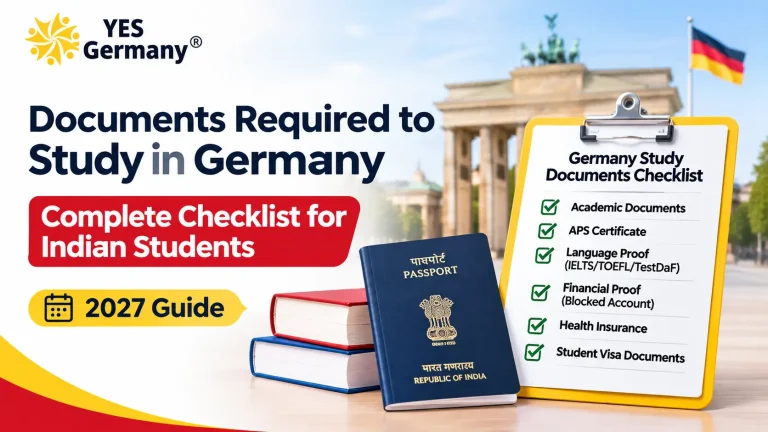
Common documents include:
- Class 10 and 12 marksheets and certificates.
- APS certificate, where applicable.
- Valid passport.
- Language proficiency certificates.
- JEE results or Indian university transcripts, if relevant.
- Studienkolleg and FSP results, if applicable.
- CV, motivation letter or portfolio, where required.
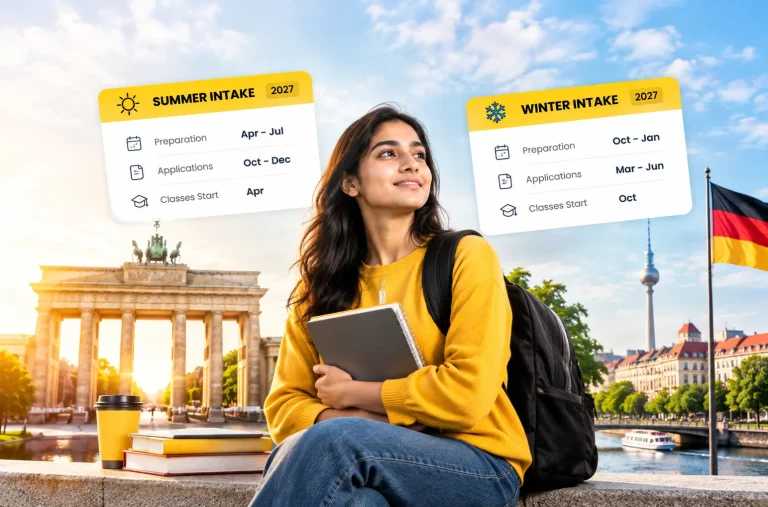
Germany generally has two academic intakes:
| Intake | Typical commencement |
| Winter semester | October |
| Summer semester | April |
Deadlines vary by university and programme. Some courses accept applications only for the winter semester.
Step 6: Arrange APS Verification and Calculate Your Budget
The Academic Evaluation Centre (APS) verifies academic qualifications and documents issued by Indian educational institutions. Its certificate is generally required for Indian student visa applicants, subject to applicable exemptions.
APS verification does not guarantee university admission.
How much money should you prepare?
For 2026, the German student visa requires proof of at least €11,904 in a blocked account, equivalent to €992 per month.
However, this is not your complete study budget.
| Expense | What to include |
| Blocked account | Minimum annual living-expense requirement |
| Tuition fees | Depends on institution and state |
| Semester contribution | University-specific charges |
| Accommodation | Rent and deposit |
| Daily expenses | Food, transport and personal costs |
| Other expenses | Health insurance, travel and initial settlement |
Many public universities charge no general tuition fees, but exceptions apply. For example, Baden-Württemberg generally charges non-EU students €1,500 per semester in applicable cases. Some Bavarian universities also charge international tuition fees.
Create your budget using the actual fees and accommodation costs of your shortlisted universities rather than relying on a single national estimate.
Step 7: Apply for a German Student Visa
After receiving admission to a university or Studienkolleg, begin the appropriate national visa application through the German Missions in India.
Depending on your application category, documents may include:
- Passport and academic certificates.
- APS certificate, where required.
- Admission letter.
- Recognised language certificates.
- Proof of financial resources.
- CV and motivation letter.
- Health insurance documentation.
Use the Consular Services Portal and follow the latest checklist for your specific admission category. Submitting documents does not guarantee visa approval.
Step 8: Prepare for Your Arrival
Before travelling, arrange accommodation, health insurance and university enrolment.
After reaching Germany, students generally need to complete university registration, register their residential address (Anmeldung), arrange banking facilities where required and complete residence permit formalities.
Book accommodation early, particularly in cities with high student demand.
Your Germany Application Timeline
| When to start | What to do |
| 12 months before | Check eligibility, select courses and begin language preparation |
| 9 months before | Arrange APS verification and shortlist institutions |
| 6 months before | Apply to universities or Studienkollegs and prepare finances |
| 3 months before | Complete visa formalities and arrange accommodation |
| Before departure | Confirm enrolment, insurance and travel arrangements |
Common Mistakes Indian Students Should Avoid
- Applying directly to bachelor’s programmes without checking eligibility.
- Assuming every public university is tuition-free.
- Choosing a Studienkolleg without checking FSP recognition.
- Treating the blocked account amount as the entire education budget.
- Assuming English-medium schooling automatically waives language tests.
- Missing university-specific application deadlines.
How YES Germany Can Support Your Study Plans
YES Germany assists Indian students with course selection, university applications, APS documentation, German language preparation, financial documentation and student visa guidance.
Understanding your academic eligibility first can help you select the appropriate admission route and plan your transition to higher education in Germany.
Frequently Asked Questions
1. Can I study in Germany after Class 12 with less than 70%?
The standard Studienkolleg and one-year Indian bachelor’s pathways under the revised 2026/27 criteria require at least 70% in Class 12. Students below this threshold should verify whether any separate recognised qualification pathway applies to their circumstances.
2. Can Commerce students without Mathematics study in Germany?
Some business and humanities programmes may accept them, but universities can specify Mathematics or other subject prerequisites. Check individual course requirements.
3. Can I study in Germany in English without learning German?
Yes, some English-taught bachelor’s programmes are available. However, students should consider everyday communication, accommodation and integration requirements, even when their degree is taught in English.
4. Does passing the FSP guarantee bachelor’s admission?
No. It establishes subject-related eligibility. Students must still meet university admission and selection requirements.
5. Is there an age limit for studying in Germany after 12th?
There is no general nationwide maximum age limit for bachelor’s admission. Individual admission and visa requirements still apply.