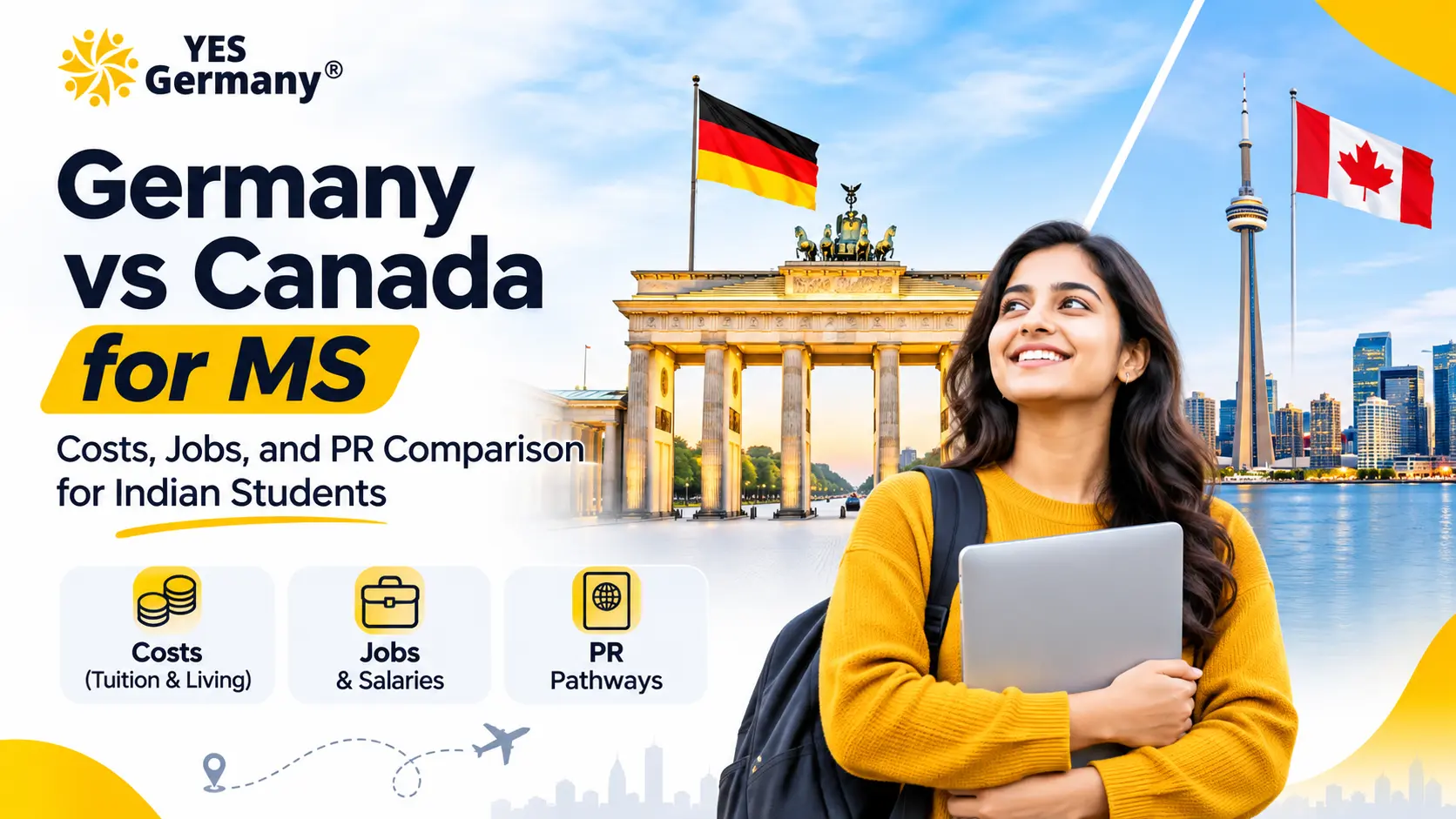
A Master’s degree abroad is a major financial and career decision. For Indian students, Germany and Canada are two popular destinations, but they offer different advantages.
Germany attracts students with comparatively affordable public university education, strong engineering and technology industries, and structured pathways to long-term residence. Canada offers an established international education system, an English-speaking academic environment and post-graduation work opportunities for eligible students.
However, tuition fees alone do not determine affordability, and obtaining a post-study work permit does not guarantee permanent residency. Understanding the differences in education costs, employment opportunities, and immigration requirements can help you choose the right destination.
So, Germany vs Canada for MS: which country offers better value for Indian students in 2026? Let’s compare the key factors.
1. Cost of Studying MS in Germany vs. Canada
Germany is generally more affordable in terms of tuition fees, particularly at public universities for MS in Germany. Canadian universities usually charge higher tuition fees to international students. However, your overall expenses depend on the university, programme, city, and lifestyle.
| Expense | Germany | Canada |
| Tuition fees | Most public universities charge no tuition for many Master’s programmes, although exceptions apply. | International graduate tuition averaged CAD 24,028 per year in 2025/26. Actual Master’s fees vary by university and field. |
| Living expenses | Approximately €900–€1,200 per month, depending on the city and lifestyle. | Costs vary by city, accommodation, and lifestyle. |
| Financial proof for a student visa | Students must demonstrate sufficient funds to cover their stay in Germany. | CAD 23,448 annually is the minimum living expense financial proof for one applicant outside Quebec applying from 1 September 2026. Tuition and transportation are additional. |
What should students know about tuition fees?
Most German public universities do not charge tuition for many Master’s programmes, although students generally pay a semester contribution. Exceptions include public universities in Baden-Württemberg, which generally charge non-EU/EEA students €1,500 per semester, and certain universities in Bavaria. Private universities have separate fee structures.
In Canada, tuition varies by institution and specialisation. The CAD 24,028 figure is a national average for international graduate students, not a fixed fee for every Master’s programme.
It is also important to distinguish Canada’s financial-proof requirement from actual living expenses. The CAD 23,448 amount is the minimum living-expense proof for one applicant outside Quebec from September 2026, not a complete estimate of annual study costs.
Overall, Germany generally offers a lower tuition burden, while students should compare accommodation and other living expenses in their shortlisted cities.
Sources: DAAD – Costs of Education and Living, Statistics Canada – Tuition Fees 2025/26.
2. Job Opportunities After an MS in Germany vs. Canada
Career opportunities after an MS depend on your specialisation, industry demand, practical experience, and work authorisation. Both countries offer opportunities in technology, engineering, and research, but their employment markets have different strengths.
Job Opportunities After MS in Germany
Germany has established industrial and technology sectors that create opportunities for graduates across several specialisations.
- Mechanical and Automotive Engineering: Opportunities include vehicle development, robotics, industrial automation and advanced manufacturing.
- Computer Science and Data Science: Graduates can explore software development, artificial intelligence, cybersecurity, cloud computing, and data analytics.
- Renewable Energy: Opportunities exist in energy systems, sustainable manufacturing, and environmental technology.
- Research and Development: Universities, research institutions, and private companies recruit graduates for specialised technical and research positions.
Employment opportunities vary by location. Munich and Stuttgart have strong automotive and engineering industries, Berlin has a prominent technology and startup ecosystem, and Frankfurt is an important financial and fintech centre.
German language proficiency can improve access to employment, particularly in positions involving local clients and workplace communication. Although some international companies offer English-speaking roles, learning German can broaden employment opportunities.
Job Opportunities After MS in Canada
Canada offers career opportunities in technology, healthcare, financial services, engineering, research and professional services.
- Computer Science and Data Science: Software engineering, artificial intelligence, cybersecurity, and data analytics.
- Healthcare and Life Sciences: Biotechnology, pharmaceutical research, health informatics, and healthcare technology.
- Finance and Business Analytics: Financial analysis, risk management, business intelligence, and fintech.
- Engineering: Civil, mechanical, electrical, and environmental engineering, depending on regional demand.
- Research and Professional Services: Specialised research, consulting, and technical positions.
Toronto is a major financial and technology centre, Vancouver has opportunities in technology and clean energy, Montreal has a strong presence in artificial intelligence and aerospace, and Calgary offers opportunities in energy and engineering.
Unlike Germany’s strong industrial manufacturing base, Canada’s employment landscape is significantly influenced by provincial labour markets. Graduates should consider regional hiring demand, occupation-specific requirements and credential recognition. Certain regulated professions also require professional licensing.
Work Opportunities During and After an MS Degree
Both countries allow eligible international students to work while studying and offer post-study employment options.
Germany: International students from non-EU countries can work up to 140 full days or 280 half-days annually. Alternatively, they can work up to 20 hours per week during lecture periods, subject to applicable rules.
After graduation from a German higher education institution, eligible graduates can apply for an 18-month residence permit to seek qualified employment.
Official source: Make it in Germany—Study and Work.
Canada: Eligible international students can work up to 24 hours per week off campus during regular academic sessions and work unlimited hours during scheduled academic breaks.
After graduation, eligible students may apply for a Post-Graduation Work Permit (PGWP). Graduates of eligible Master’s programmes lasting at least eight months can qualify for a PGWP of up to three years.
Master’s graduates must meet the applicable language requirement of CLB 7 in English or NCLC 7 in French across all four language abilities. They are exempt from the PGWP field-of-study requirement but must satisfy the other eligibility conditions.
Official sources: IRCC – Working Off Campus and IRCC – PGWP Eligibility.
3. PR After MS in Germany vs Canada
Germany and Canada have different permanent residency pathways for international graduates. Germany primarily offers settlement routes linked to skilled employment and residence requirements, while Canada uses immigration programmes such as Express Entry.
PR After MS in Germany
Graduates of German universities may qualify for a settlement permit (Niederlassungserlaubnis) after holding a qualifying skilled-worker residence permit and completing at least two years of qualifying employment.
The main requirements generally include:
- At least two years holding a qualifying skilled-worker residence permit.
- At least 24 months of statutory pension contributions.
- German language proficiency at B1 level.
- Suitable employment and sufficient living space.
- Other applicable legal and integration requirements.
The two-year period relates to qualifying residence and employment after transitioning to the relevant skilled-worker residence status, not the time since university admission or graduation.
Another option is the EU Blue Card. Eligible Blue Card holders may qualify for a settlement permit after 27 months of qualifying employment with A1-level German proficiency, or 21 months with B1-level German proficiency, subject to other conditions. This is a separate route and does not automatically apply to every Master’s graduate.
PR After MS in Canada
One important permanent residency pathway for international graduates is the Canadian Experience Class (CEC), which operates under Express Entry.
To qualify, applicants generally need:
- At least one year of skilled Canadian work experience, equivalent to 1,560 hours, within the previous three years.
- Employment in an eligible NOC TEER 0, 1, 2, or 3 occupation.
- Paid work experience gained legally in Canada.
- The required English or French proficiency: CLB 7 for TEER 0 and 1 occupations and CLB 5 for TEER 2 and 3 occupations.
Work experience gained while studying full-time, including co-op placements, does not count towards the CEC minimum requirement.
Meeting the eligibility criteria does not guarantee permanent residency. Candidates must create an Express Entry profile and receive an Invitation to Apply (ITA), based on their Comprehensive Ranking System (CRS) score and selection draws.
Official source: IRCC – Canadian Experience Class.
Germany vs. Canada for Permanent Residency
Germany may appeal to graduates seeking a structured settlement route through skilled employment and German language proficiency. Canada offers several immigration pathways, but permanent residency through Express Entry depends on eligibility, CRS rankings, and invitations to apply.
Neither country guarantees permanent residency after an MS degree. Employment, language skills, and immigration eligibility remain important factors.
4. Germany vs Canada for MS: Which Country Is Better for Your Goals?
The following table summarises the main differences between the two destinations.
| Comparison factor | Germany | Canada |
| Tuition fees | Many public universities offer low or no tuition fees. | Generally higher for international students. |
| Language | German is valuable for employment. | English is widely used; French is important in certain regions. |
| Part-time work | 140 full days or 280 half-days annually. | Up to 24 hours per week during regular academic sessions. |
| Post-study option | 18-month job-search residence permit. | PGWP of up to three years for eligible graduates. |
| Employment | Engineering, automotive, manufacturing, and technology. | Technology, healthcare, finance, and engineering. |
| PR pathway | Settlement permit and EU Blue Card route. | Express Entry, including the Canadian Experience Class. |
Germany may be a stronger option for students prioritising affordable public university education and careers in engineering, manufacturing, or technology. Canada may suit those who prefer an English-speaking academic environment and want to explore its post-graduation work permit and immigration pathways. Your decision should depend on your specialisation, financial resources, and eligibility for the programmes you are considering.
How YES Germany Can Help With Your Study Plans
For students considering Germany for their Master’s degree, navigating university admission requirements, APS certification, financial documentation, and visa procedures can involve several steps. YES Germany provides guidance with university selection, applications, APS certification, German language preparation, financial documentation, and student visa procedures.
If you are comparing Germany and Canada, YES Germany can help you assess German university options based on your academic qualifications, preferred Master’s specialisation, budget, and long-term career plans. This can help you determine whether Germany aligns with your academic and professional objectives before making your final study destination decision.
Frequently Asked Questions
1. Can I apply for an MS in Germany or Canada with a three-year bachelor’s degree?
Yes, some universities accept three-year degrees, but recognition and admission requirements vary by institution and programme.
2. Is GRE mandatory for MS admissions in Germany and Canada?
No. GRE requirements depend on the university, programme and applicant’s academic background.
3. Can I get scholarships for MS programmes in both countries?
Yes. Universities, government organisations and other funding bodies offer scholarships, subject to eligibility and availability.
4. Do I need to learn German if my Master’s programme is taught in English?
German may not be required for admission, but learning it can improve everyday communication and employment prospects.
5. When should Indian students start applying for an MS abroad?
Ideally, begin researching universities and preparing application documents 9–12 months before your intended intake. Some programmes have earlier deadlines.