
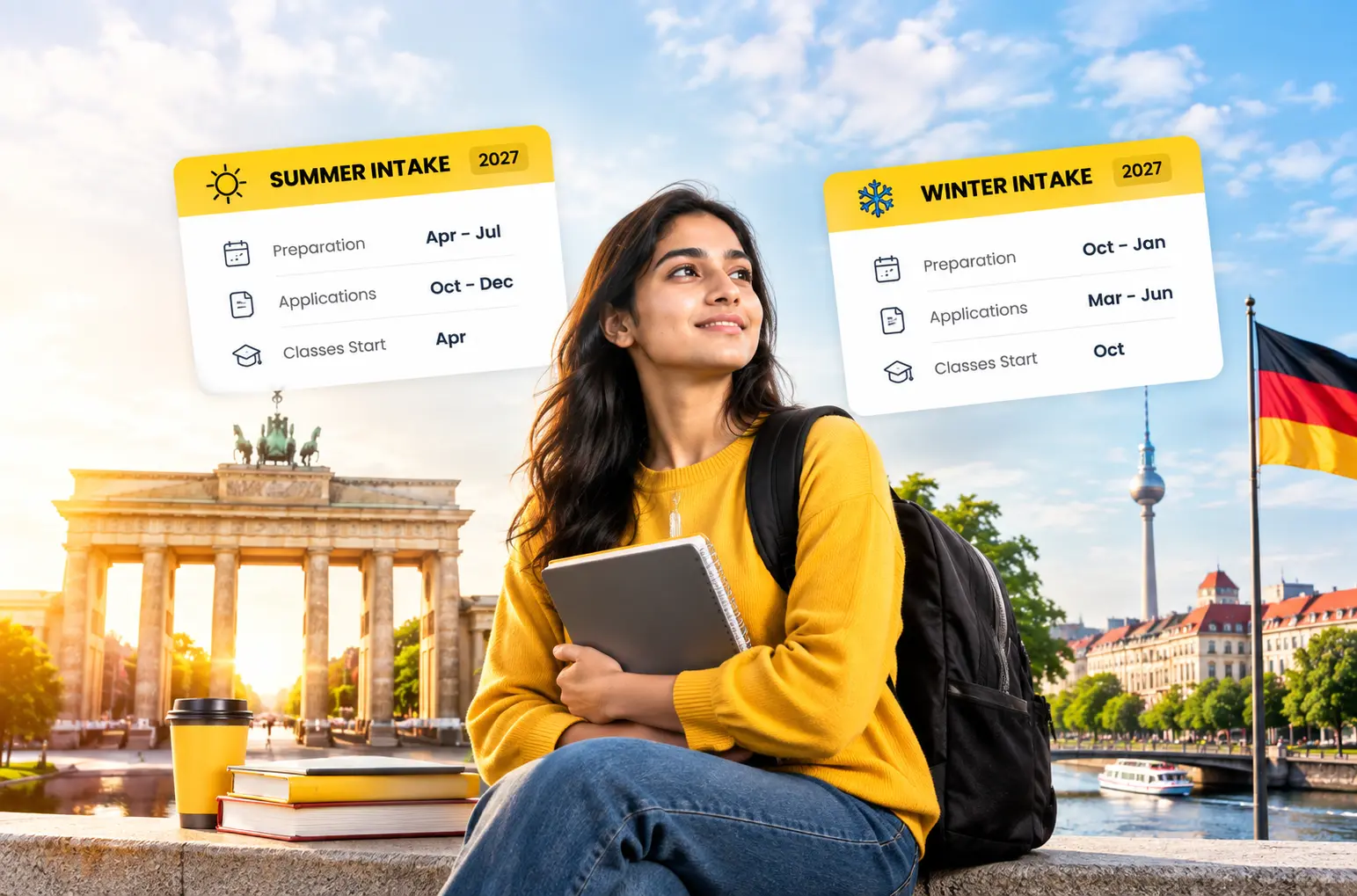
For students aiming for a German university in 2027, deciding about summer or winter intake becomes important. There are two main intakes — winter and summer. The winter intake usually begins in October, while the summer intake starts in April. But here’s the catch: not every course is open in both intakes.
Your choice between the two intakes can affect which courses are available to you. This is a significant point to consider when comparing the summer vs winter intake Germany. The application timeline can also be different. So, should you go for the winter intake or wait for summer? Here’s a simple comparison of both intakes to help you decide which one fits your study plans.
Summer Intake vs Winter Intake Germany — Quick Overview
| Factor | Winter Intake | Summer Intake |
|---|---|---|
| Classes usually begin | October | April |
| Application period | Often around April–July | Often around November–January |
| Course availability | Generally higher | Generally lower |
| Competition | Can be high | May be lower for some courses |
| Best suited for | Wider course choice | Students who either missed their winter intake or need to start earlier/later |
These are general patterns. Some programs may have completely different deadlines. For example, the DAAD program database shows different deadlines for individual courses, including separate deadlines for non-EU applicants.
What is Winter Intake in Germany?
The winter intake is the main admission cycle at most German universities also called the fall semester. Classes usually begin in September or October.
For Indian students, it can be a good option because more courses are available during this intake. The winter intake is when most universities open admissions for a larger number of courses. This includes popular areas like engineering, computer science and management.
There is no common deadline for all the courses. Each university decides the last date of application for its courses. For a Winter 2027 intake, begin shortlisting your courses and checking their deadlines early.
What is Summer Intake in Germany?
The summer intake also called the summer semester or Sommersemester, usually begins in April. The number of programs available in this intake is lower. This does not mean that summer intake is a poor choice. Students who missed the winter deadline can use summer intake as a fallback. Students who complete their degree later in the year may also find it a more practical starting point. Additionally, the students can also find suitable programs that specifically belong to this intake. For Summer 2027, the application process starts well before April. It is worth having your documents ready during 2026.
Summer vs Winter Intake Germany — Key Differences
Course Availability
This is one of the biggest differences between the two intakes.
The winter intake usually has a larger selection of courses. Many universities open their main admission cycle during winter, so students may find more choices across different fields.
Summer intake has fewer options, although the exact number depends on the subject and university. Therefore, students should not choose an intake first and search for a course later. It is better to shortlist suitable programmes and then check which intake they accept.
If your preferred course is available only in winter, waiting for summer may mean waiting another year.
Application Deadlines
Deadlines are another important factor in the winter vs summer intake Germany comparison.
For many courses, winter applications are due a few months before the October start. Summer applications are usually due before the April start. But these are only general timelines. The university decides the actual deadline for the program.
It’s advisable to keep at least 4-6 weeks of extra time for your document verification, admission processing, visa formalities, accommodation and travel.
Competition & Seat Availability
The winter intake attracts more applicants because it has more courses and is the main admission cycle. This can mean more competition, especially for popular programmes.
The summer intake may have fewer applicants for some courses. But that does not mean admission is easier. The courses with limited seats or strict academic requirements can be highly competitive.
So, don’t choose an intake just because you think there will be fewer applicants. Your academic profile, eligibility and the course requirements matter more.
Scholarship Opportunities
Scholarships don’t follow a fixed winter or summer pattern. Some have separate application deadlines and selection rules. Keep a watch for the following:
- Scholarship deadlines may be different from the university’s admission deadlines.
- Some scholarships are available only for certain programs or universities.
- Don’t assume that the winter intake will always have more funding options.
Example: If you’re applying for a DAAD scholarship, check its application period separately. It may be earlier than the university’s admission period.
Which is the Best Intake for Germany — Summer or Winter?
So, how do you decide which is the best intake for Germany? For most students, winter intake is the more practical choice. However, summer intake can be the better option in certain situations.
Choose winter intake if:
- Your preferred course is offered only in winter.
- You want the widest possible choice of universities and programs.
- You want winter’s larger orientation cohort to help you settle in and build a peer group quickly.
- You want more time to prepare your application before the semester starts.
Choose summer intake if:
- Your preferred programme accepts applications only in summer.
- You missed the winter deadline.
- Your academic timeline makes April a better starting point.
- You have found a suitable course with summer admission.
In short, do not select an intake simply because it is considered more popular. Your course availability should be the first factor you check.
Eligibility & Documents Required for Both Intakes
The basic eligibility requirements are usually similar for both intakes. The requirements can vary by university and program. It’s a good practice to verify them on the official program page before applying.
Indian students may commonly need:
- A recognised bachelor’s degree for Master’s applications
- Marksheets and certificates
- Proof of English or German language proficiency
- CV or résumé
- Statement of Purpose or motivation letter
- Passport
- Letters of recommendation, if required
- APS certificate, where applicable
- Proof of other programme-specific requirements
FAQs
1. Which intake is better for Indian students — summer or winter?
Winter is usually better because more programs are available. Summer works too if your course accepts April applications.
2. Can I apply for both intakes in the same year?
Yes, if your course is available in both intakes.
3. Is winter intake more competitive than summer intake in Germany?
It can be, as more students usually apply in winter. But it depends on the course and university.
4. Do all German universities offer a summer intake?
No. Many universities, especially for Bachelor’s programs, only admit students in winter. Summer intake is more common for Master’s programs.
5. Is the IELTS/TestDaF different for summer vs winter intake?
No — the language requirement not based on the intake. If a course requires IELTS 6.5 or TestDaF 4, that applies to both intakes equally.
Winter is usually better because more programs are available. Summer works too if your course accepts April applications.
Yes, if your course is available in both intakes.
It can be, as more students usually apply in winter. But it depends on the course and university.
No. Many universities, especially for Bachelor’s programs, only admit students in winter. Summer intake is more common for Master’s programs.
No — the language requirement not based on the intake. If a course requires IELTS 6.5 or TestDaF 4, that applies to both intakes equally.
Final Takeaway
Your intake decision should follow your course shortlist, not the other way around. Once you’ve picked a program, confirm its exact deadline directly on the university’s page — general timelines won’t apply to every course. If you’re weighing summer 2027 against winter 2027 and want a second opinion on your shortlist, YES Germany can help you map out which intake fits your profile and timeline.