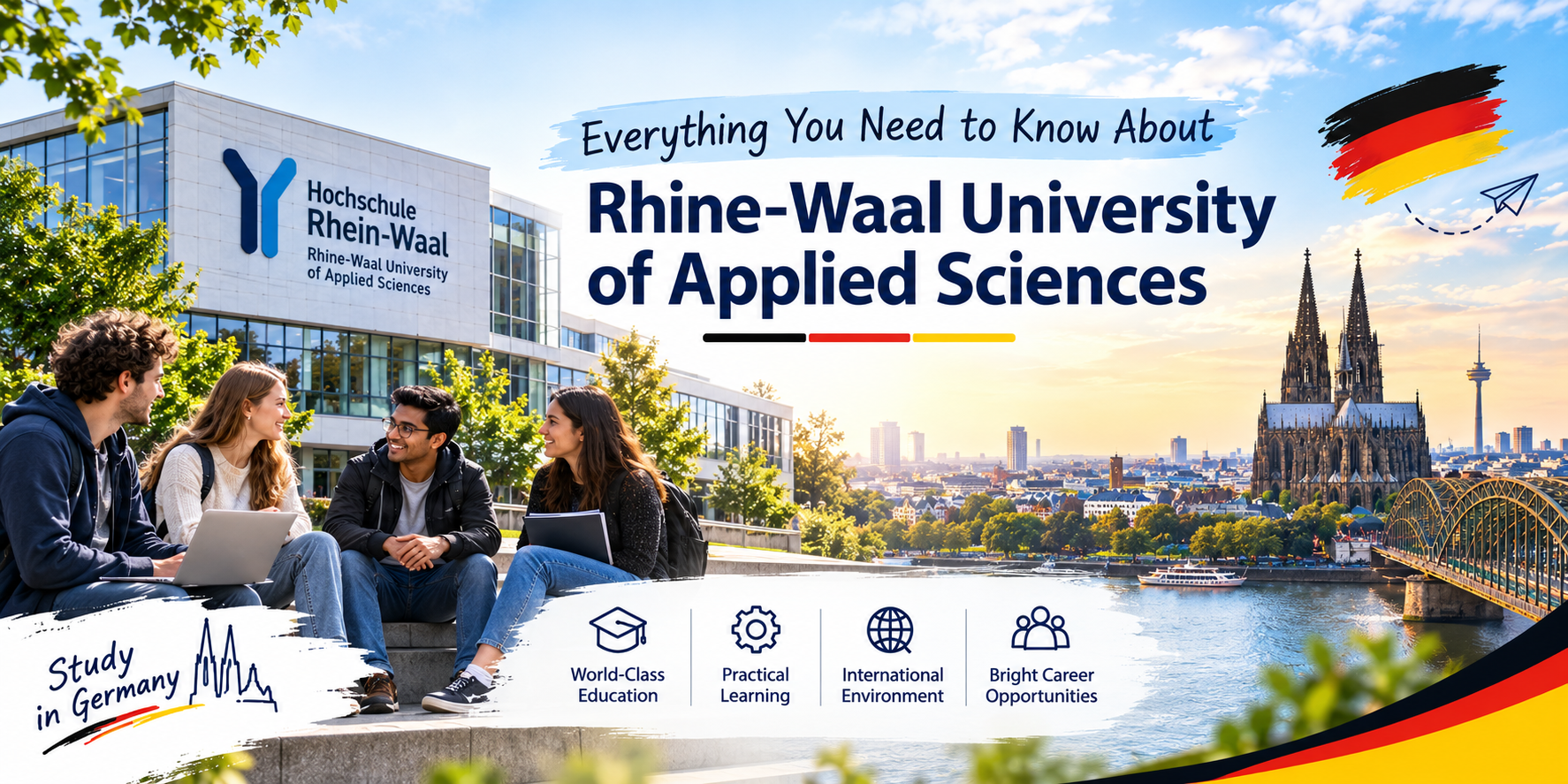
For students planning to study in Germany, Rhine-Waal University of Applied Sciences offers a broad range of programmes across two campuses in Kleve and Kamp-Lintfort, with many degrees taught in English. The university currently lists 25 bachelor’s and 11 master’s programmes, spanning engineering, technology, life sciences, economics, social sciences, and related fields.
For international applicants, however, the important questions go beyond language of instruction. Programme availability, admission requirements, application routes, internship requirements, semester costs, and campus location can all affect whether a particular degree fits into their plans.
Information checked for the 2026/27 application cycle. Programme availability, fees, deadlines, and admission requirements can change, so applicants should verify the latest details on the official Rhine-Waal website before applying.
Why Consider Rhine-Waal University of Applied Sciences?
Rhine-Waal is a relatively young German university of applied sciences, established in 2009. Its academic portfolio covers technology, engineering, life sciences, economics, social sciences, communication, and environmental studies.
The important distinction is its applied-learning model. The university describes its programmes as combining academic knowledge with real-world application, while several programmes include internship or practical components. This makes it relevant for students who want their degree to connect classroom learning with professional contexts.
Its international character is another defining feature. The university currently reports students from more than 120 nationalities, creating a multicultural academic environment across its two campuses.
English-Taught Courses at Rhine-Waal
For students looking for an English-taught Bachelor’s in Germany, Rhine-Waal offers programmes across a wide range of academic areas. Its programme directory includes options in engineering, technology, business, life sciences, sustainability, social sciences, design, agriculture, and tourism.
Some of the English-taught areas available across its portfolio include:
- Engineering and technology: Engineering, Infotronic Systems Engineering, and Mobility and Logistics
- Business and economics: International Business Administration and International Business and Management
- Sustainability and environment: Engineering for Sustainability, Environment and Energy, Nature-Inspired Materials, and Sustainable Agriculture
- Social sciences: International Relations and Gender and Diversity
- Life sciences: Bioengineering and related biological and agricultural fields
- Design and creative fields: Information and Communication Design
- Tourism: Sustainable Tourism
However, applicants should not treat every programme listed in the university’s directory as currently open for admission. Rhine-Waal marks some programmes as no longer accepting new enrolments, so the availability of a degree should be checked before making an application decision.
The university’s official programme directory allows students to check the degree level, language of instruction, campus, start semester, and enrolment status of individual programmes.
The same principle applies to students considering a Master’s in Germany. Rhine-Waal offers English-taught postgraduate programmes in areas including biological resources, design and interaction, economics and finance, information engineering and computer science, international management, psychology, sustainable development management, and usability engineering.
The key takeaway: check the individual programme page rather than relying on a university-wide claim that a course is English-taught or currently accepting applications. Requirements, language, intake, and enrolment status can differ between programmes.
Two Campuses, Different Academic Focuses
The campus matters because programmes are distributed across Rhine-Waal’s academic faculties.
Kleve hosts the Faculties of Technology and Bionics, Life Sciences, and Society and Economics. Students can find programmes spanning engineering, agriculture, biological sciences, international business, economics, international relations, and sustainability.
Kamp-Lintfort is home to the Faculty of Communication and Environment, with programmes covering design, computer science, information engineering, environmental studies, logistics, and international business.
For applicants, the programme should therefore be the starting point, with campus considered alongside its language, admission requirements, and academic focus.
Admission and English-Language Requirements
For English-taught bachelor’s programmes, Rhine-Waal generally requires proof of English proficiency at the level specified by the individual programme, commonly B2. Applicants should check the programme page and accepted certificates before applying.
Master’s applicants should check requirements programme by programme. Depending on the course, these may include a relevant bachelor’s degree, minimum academic performance, English proficiency, and additional requirements such as an internship or aptitude assessment. For example, the university’s current master’s requirements list B2 English for several programmes and C1 for Usability Engineering.
This is why students should avoid treating “English-taught” as the only admission criterion.
Tuition Fees and Semester Costs
Rhine-Waal does not charge tuition fees. Tuition fees were abolished at public higher education institutions in North Rhine-Westphalia in 2011, and Rhine-Waal confirms that this applies to both German and international students.
That does not mean studying is completely cost-free.
For the summer semester 2026/27, Rhine-Waal lists a semester contribution of €347.10. This comprises the mandatory social services contribution, the student representative body contribution, the Germany Semester Ticket, and smaller contributions for university sports and music.
Students should therefore distinguish between tuition fees and the semester contribution when calculating the cost of studying at Rhine-Waal.
How International Students Apply
International applicants to Rhine-Waal generally apply through uni-assist, following the programme-specific requirements for documents, eligibility and deadlines. Applicants should check their chosen programme carefully, as requirements can vary.
A practical sequence is:
Choose the programme → check eligibility → verify language requirements → prepare documents → check the application route and deadline → apply.
Students from India should begin documentation early. Depending on their circumstances, an APS certificate may be required for the German student visa process. APS India verifies academic documents and qualifications but does not make university admission or visa decisions.
For additional guidance on Germany’s application process and pre-arrival requirements, Yes Germany can be used alongside the official Rhine-Waal, Uni-Assist, and APS sources.
Is Rhine-Waal Suitable for Your Study Plan?
Whether Rhine-Waal fits your plans depends less on the university name than on the specific programme you intend to study. Applicants should consider the course content, academic eligibility, language of instruction, campus location, internship requirements, semester contribution, and application process before making a decision.
For students planning a Bachelor’s in Germany or a Master’s in Germany, checking these details at programme level can help avoid common application mistakes. A course may differ from another programme at the same university in its language requirements, intake, admission criteria, or current enrolment status.
The most reliable approach is therefore to identify the programme that matches your academic and career plans first, then verify its latest requirements on the official Rhine-Waal programme page before applying.
Frequently Asked Questions
1. Is Rhine-Waal University of Applied Sciences a public university?
Yes. Rhine-Waal is a public university of applied sciences in North Rhine-Westphalia, Germany.
2. Is German required for an English-taught programme?
For English-taught bachelor’s programmes, Rhine-Waal states that German certification is not required. English-language requirements still apply.
3. Does Rhine-Waal have an international student community?
Yes. The university has students from more than 120 nationalities, giving its campuses a strongly international character.
4. What makes a University of Applied Sciences different from a traditional university?
Universities of Applied Sciences generally place greater emphasis on application-oriented education, practical projects, and links between academic learning and professional practice. The exact study structure depends on the programme.
5. Does Rhine-Waal offer both Bachelor’s and Master’s degrees?
Yes. Rhine-Waal offers undergraduate and postgraduate programmes across areas including technology, life sciences, economics, society, and related disciplines.